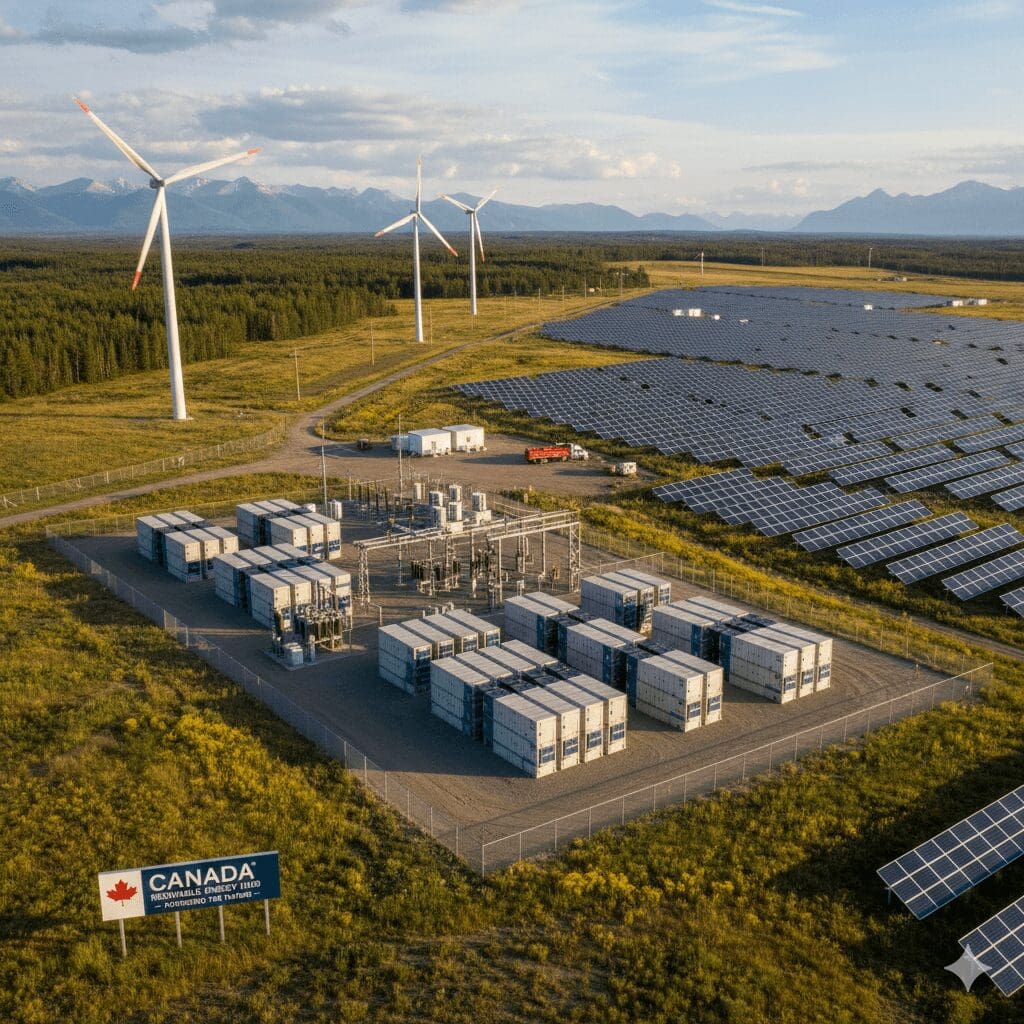
As of late 2025, Canada is accelerating toward ambitious climate goals, including a net-zero economy by 2050 and new regulations aimed at a predominantly clean grid. Wind and solar, now among the cheapest forms of new generation, are expanding rapidly. Yet their inherent variability, producing power only when the wind blows or the sun shines, creates challenges for maintaining reliability, stability, and seamless integration at higher penetrations.
Battery Energy Storage Systems (BESS) are emerging as the transformative solution. Continued cost declines have pushed lithium-ion battery prices to record lows, making large-scale deployments increasingly economical without significant subsidies. In Canada, storage development is accelerating: Ontario alone has procured nearly 3 GW through competitive processes, highlighted by the 250 MW Oneida project coming online soon, with even larger systems under construction. Nationally, planned additions could increase installed capacity fivefold by 2030, enabling deeper renewable integration while delivering essential grid services.
BESS provide the long-missing flexibility needed for a high-renewables grid by decoupling generation from demand, smoothing variability, offering fast-response capacity, and restoring critical system attributes like inertia and frequency stability. As costs fall and hybrid renewable-plus-storage projects demonstrate compelling economics, BESS are rapidly evolving from supplemental assets to the essential backbone of Canada’s firm, flexible, and clean electricity future.
The Intermittency Challenge
Canada’s path to a net-zero electricity grid depends on rapidly expanding clean renewable sources such as wind and solar power. These technologies have seen dramatic cost declines over recent decades, making them among the cheapest options for new electricity generation in most regions. Yet they face a fundamental challenge that has long hindered large-scale integration: intermittency.
Solar and wind generate power only when the sun is shining or the wind is blowing. Because these natural resources are variable and unpredictable, fluctuating on scales from minutes to seasons, they are known as intermittent resources.
Demand and Supply
To understand the transformative role of BESS in the renewable energy landscape, we must first grasp the electric grid’s core challenge, which is the balancing of supply and demand in real time.
Unlike water, oil, or natural gas, electricity cannot be easily stockpiled for later use. It is inherently instantaneous, meaning that every time a light is switched on or a factory starts a machine, a generator somewhere must immediately increase output to match that exact demand.
For the grid to remain stable, total generation must match total consumption exactly, down to the millisecond. If supply exceeds consumption (oversupply), grid frequency rises, causing induction motors (common in appliances like refrigerators, fans, and pumps) to spin faster than designed. This leads to increased vibrations, excess heat buildup, and mechanical stress, potentially damaging bearings or shortening equipment life.
If consumption exceeds supply (undersupply), grid frequency drops, causing instability that can lead to issues like brownouts. If the shortage is severe and lasts long enough, automatic safety systems kick in that quickly cut off some power plants or customers to stop massive damage and a chain reaction of failures. While effective at protecting the overall grid, this often causes large-scale blackouts in affected areas.
Intermittent Renewables and Grid Stability
The challenge presented by wind and solar is not merely a matter of when they generate, but how they generate power and what they displace on the grid. Integrating large volumes of these intermittent resources introduces two major technical destabilizers: Reduced System Inertia and Increased Ramp Rates.
Challenge 1: The Loss of Inertia (The “Heavy Flywheel” Effect)
Traditionally, the stability of the grid was protected by the sheer mass of large, synchronous generators (think turbines in coal, gas, and nuclear power plants). These massive, rotating components act like a heavy flywheel. When a sudden power imbalance occurs (e.g., a large power plant unexpectedly trips offline), the sheer rotational inertia of all remaining synchronous generators resists the immediate frequency drop. This resistance provides a critical, few-second buffer, giving automated control systems and grid operators time to react and inject new power to stabilize the system.
Wind and solar projects are connected to the grid using inverters, which have no mechanical rotating parts and therefore provide little to no inherent inertia. As the percentage of solar and wind on the Canadian grid increases, the overall system inertia drops. This makes the grid more “brittle,” as it is less able to absorb shocks. Any imbalance causes faster, larger frequency deviations, increasing the risk of the system protection mechanisms tripping, as described earlier.
Challenge 2: High Ramp Rates and Forecasting Limits
Grid operators manage power plants based on forecasts, planning hours or even days ahead. Intermittent resources constantly challenge this process. Consider a large solar farm under clear skies. If a sudden, dense cloud passes over the entire array, the power output can drop almost instantaneously, creating a massive, sudden power deficit (a downward ramp) that grid operators must instantly fill. Similarly, a fast-moving front of high wind can cause a massive power surge (an upward ramp). The speed and scale of these renewable ramps are often far greater than the generation rate of traditional plants.
Battery Energy Storage Systems
If the instantaneous nature of electricity is the problem, then storage is the solution. For the first time, large-scale batteries allow us to decouple the moment power is generated from the moment it is consumed.
Electricity Time Machines
A BESS is fundamentally a large collection of specialized, industrial-grade rechargeable batteries, built into large cabinets or containers, that function as a massive electrical time machine for the grid.
The easiest way to think of BESS is to imagine electricity not as some invisible force, but as water flowing through an enormous network of pipes. It’s a surprisingly accurate way to picture how our power grid works, and it makes the revolutionary role of BESS crystal clear.
Solar panels and wind turbines are like rain-catchment systems perched on rooftops and hilltops. When the sun shines or the wind blows, they can deliver a sudden flood of power. But when clouds roll in or the air goes still, the flow slows to a trickle or stops altogether.
This is where BESS steps in, acting like massive, intelligent reservoirs integrated directly into the grid. When solar and wind pour out more power than is needed, the batteries absorb the surplus. Then during inevitable lulls, they release a steady, precisely controlled stream of stored power to keep the pipes flowing smoothly.
Energy Conversion and Electrochemistry
Now let’s get a little nerdy – feel free to skip this section if you’re not into the physics of electron flow or AC/DC (currents – not the band).
The operation of a BESS is a precise dance between high-power electronics and solid-state chemistry. It involves two major, distinct processes: Power Conversion (electrical form change) and Electrochemical Storage (chemical energy storage).
The process of charging a BESS begins with high-voltage alternating current (AC) power drawn from the grid (or from a solar inverter). This power must be “conditioned” before it can be used by the batteries, which are inherently direct current (DC) devices.
The Power Conversion System (PCS) is the gatekeeper. Its role during charging is to act as a rectifier:
1. Grid Synchronization: The PCS ensures the incoming AC power is synchronized with the BESS’s internal voltage and power factor targets.
2. Rectification: Using high-speed switching components, typically Insulated Gate Bipolar Transistors (IGBTs) or Silicon Carbide (SiC) MOSFETs, the AC sine wave is electronically chopped and smoothed into a constant, regulated DC voltage.
3. DC Bus Regulation: This regulated DC power is fed to the DC bus that connects the PCS to the battery stacks. The PCS voltage output is precisely controlled to meet the charging requirements of the Battery Management System (BMS).
Once the electrical energy is converted to DC, the energy is stored inside the Lithium-ion (Li-ion) cells through a process called intercalation (insertion).
A Li-ion cell consists of a cathode (positive electrode, typically a metal oxide like Lithium Iron Phosphate (LiFePO4) or Lithium Nickel Manganese Cobalt Oxide (LiNiMnCoO2)), an anode (negative electrode, typically graphite), an electrolyte (a lithium salt dissolved in an organic solvent), and a separator (a permeable membrane).
The DC current supplied by the PCS applies a positive voltage across the cell terminals. This electrical potential energy drives the following reactions:
1. Lithium-Ion Movement (Li+): Lithium ions (Li+) are oxidized at the cathode, exit the structure, and are “pushed” across the electrolyte and separator.
2. Electron Flow (e–): The corresponding electrons (e–) are forced through the external DC circuit (the charging current) to the anode.
3. Storage at Anode: At the anode (graphite), the electrons and lithium ions recombine and become physically inserted (intercalated) into the crystalline structure of the graphite.
The BESS is now in a high State-of-Charge (SoC), storing energy as chemical potential energy, ready to discharge on command.
In order to be put back onto the grid, the DC power from the battery stack must be converted back to the AC format required by the grid. In order to accomplish this, the PCS acts as a bidirectional inverter:
- Inversion: The PCS again uses its IGBTs, but this time they are switched in a highly controlled sequence to reconstruct the smooth AC sine wave from the DC input.
- Grid Integration: The PCS must precisely match the output AC voltage, frequency (60 Hz or cycles per second, the standard for the North America power grid), and phase angle to that of the utility grid. This speed and precision is what allows BESS to perform high-value, instantaneous services like frequency regulation.
The efficiency of this entire round-trip process (AC -> DC -> Chemical -> DC -> AC) is typically very high for Li-ion BESS, often exceeding 85% to 90%. In other words, only 10% to 15% of the energy put into a BESS is lost during charging and discharging. This makes Li-ion BESS far more efficient than alternatives like pumped hydro (~80%) or some flow batteries (<85%).
24/7 Renewables
Beyond addressing daily intermittency, BESS play a pivotal role in transforming variable renewables into a reliable 24/7 carbon-free energy source. Traditional renewable procurement often relies on annual matching, such as purchasing of renewable energy credits (RECs) to offset non-renewable energy consumption over a year. However, on a daily basis, this leaves gaps where fossil fuels fill hourly shortfalls. In contrast, 24/7 carbon-free energy (CFE) requires hourly matching where every hour of demand is met with clean sources, eliminating reliance on grid-averaged or fossil-backed power.
Firming and Shaping
Firming (also called capacity firming or renewable firming) refers to making variable renewable energy output more consistent and dispatchable, essentially turning intermittent generation into a “firm” or dependable resource that can be relied upon like traditional power plants. It involves smoothing out short-term fluctuations (e.g., clouds passing over solar panels or sudden wind drops) and ensuring a committed level of power delivery over a period.
Shaping (sometimes called load shaping, energy shifting, or profile shaping) involves reshaping the overall energy output or demand curve to better match specific patterns, such as aligning generation with peak demand periods (e.g., evening peaks) or flattening the load for efficiency. It’s often about time-shifting larger volumes of energy (e.g., storing midday solar surplus for evening discharge) rather than just minute-to-minute smoothing.
BESS often performs firming and shaping simultaneously, especially in hybrid solar-wind setups where complementary profiles (solar daytime, wind often evening/night) reduce the needed storage depth.
Cost Decline
Once a high-cost technology limited to niche applications, BESS have undergone dramatic price reductions, crossing a critical affordability threshold in 2025. This shift, driven by manufacturing scale, competition, and technological maturity, has transformed BESS from a premium add-on to a mainstream, economically competitive solution for grid-scale renewables integration.
Historical Context and Dramatic Declines
Lithium-ion battery costs have fallen over 90% since 2010, when pack prices exceeded $1,400/kWh (in real terms). A sharp 40% drop in core equipment costs in 2024 was followed by further declines in 2025, pushing global average pack prices to record lows. Today, in global markets outside China and the US, all-in project capital expenditure (CAPEX) for long-duration (4+ hours) utility-scale BESS now stands at around $125/kWh, including equipment, installation, and grid connection.
At these levels, BESS is now viable standalone or hybrid without heavy subsidies in many markets. To illustrate, consider a typical 10 MWdc utility-scale solar PV installation in Canada, where costs average CAD 1.50–1.90 per watt before incentives, translating to CAD 15–19 million total CAPEX. Adding co-located BESS, appropriately sized at 40 MWh (10 MWdc at 4-hour duration for time-shifting midday surplus to evening peaks), adds CAD 5–7.5 million, based on global benchmarks of CAD 125–190 per kWh for full project costs, adjusted for Canadian labor and permitting.
This hybrid setup unlocks incremental revenue through time-shifting excess solar output, which can boost annual earnings by 20–30% via arbitrage and capacity payments. Such optimization might yield CAD 1–2 million extra per year for a 10 MWdc project, factoring in sufficient spot price spreads (e.g., low midday rates of CAD 50/MWh vs. evening peaks at CAD 150/MWh). Utility-scale BESS hybrids often achieve payback periods of 5–8 years, driven by stacked revenues from energy sales, ancillary services, and avoided curtailment.
Revenue Generation
BESS turn solar and wind projects into versatile revenue generators by simultaneously participating in multiple markets and services, a feature known as revenue stacking. By combining energy arbitrage with high-value ancillary services and capacity payments, BESS elevates solar and wind from intermittent generation to a dispatchable, grid-essential resource, often achieving 15–30% higher returns for the site..
Energy Arbitrage and Firming
The core revenue driver for BESS is energy arbitrage. The potential for energy arbitrage exists in markets where there are sufficient daily or intraday price differences. High renewable penetration creates volatility through overgeneration (low/negative prices midday) and evening ramps (high prices). By charging during low-price periods and discharging during evening peaks when prices spike, BESS reduces curtailment and boosts project revenues by 20–30%.
The price spread must be sufficient to exceed costs such as efficiency losses, degradation, operations, and capital recovery. In 2025, plummeting BESS costs (~$70–108/kWh packs) make arbitrage profitable in high-volatility regions, where arbitrage alone can yield $2–3/kW monthly, transforming variable solar and wind into reliable, high-value power.
Ancillary Services
BESS excels at fast-response services that are either unavailable or severely limited for standalone renewables like solar and wind, while offering clear advantages over traditional fossil generators such as natural gas peakers:
- Frequency Regulation: Batteries respond in milliseconds to maintain grid frequency (e.g., 60 Hz in North America), providing precise upward/downward adjustments far superior to the slower ramp rates of gas turbines or the complete inability of standalone solar and wind to respond independently.
- Voltage Support: BESS maintains power quality by injecting or absorbing reactive power on demand, a capability that standalone solar inverters can offer to a limited extent but wind turbines struggle with in weak grid areas. Gas peakers, while capable, are less flexible and often operate inefficiently at partial loads for this purpose.
- Black Start Capability: BESS can restart the grid after a major outage without needing external power, serving as an independent “spark” to energize transmission lines and bootstrap larger generators.
These ancillary services provide steady, high-margin income streams, often with premium pricing due to performance superiority over gas-based alternatives.
Peak Demand
Hybrid systems like solar-plus-storage and wind-plus-storage are rapidly overtaking natural gas peaker plants as the most cost-effective resources for meeting peak demand. As battery costs continue to fall, 4-hour BESS installations are now frequently less expensive than new gas peakers, whose levelized cost of energy (LCOE) commonly ranges from $151 to $198/MWh. This is particularly true when accounting for emissions, public-health impacts, and the inherent inefficiencies of cycling gas turbines.
This shift is already playing out in jurisdictions like California and New York, where utility-scale BESS projects are directly replacing proposed or aging peaker plants, many of which are located in disadvantaged communities. Similar momentum is emerging in Canada, with provinces such as Alberta and Ontario seeing wind-plus-storage systems achieve lower LCOE than gas peakers.
By making solar dispatchable and multifunctional, BESS not only generates robust revenues but positions renewables as the backbone of a reliable, low-carbon grid.
Challenges and The Road Ahead
Despite their many advantages and plummeting costs, BESS projects in Canada still grapple with regulatory, grid interconnection, and financing challenges. These must be overcome to sustain their growth and fully realize their pivotal role in the nation’s renewable energy transition.
Permitting and Siting
Large-scale BESS projects often encounter lengthy and complex permitting processes, involving environmental assessments, zoning amendments, and public consultations. In provinces like Ontario, developers must comply with Class Environmental Assessments and engage stakeholders, leading to delays amid rising local opposition fueled by safety fears (e.g., thermal runaway risks) and misinformation.
Municipalities, such as Ottawa, have introduced stricter fire safety and siting regulations in 2025 to address these issues, sometimes stalling projects.
Supply Chain Resilience
Global reliance on critical materials, such as lithium and nickel, exposes Canada to supply disruptions. While the country leads in mining and has attracted gigafactories (e.g., Stellantis-LG in Windsor, operational by 2025), full domestic manufacturing remains nascent.
Federal investments in innovation and critical minerals aim to foster an end-to-end ecosystem, reducing vulnerabilities and creating jobs.
Regulatory Frameworks
Provincial market structures vary, with some not fully compensating BESS for stacked services like arbitrage, frequency regulation, and capacity. As deployment surges (e.g., Ontario’s procurements targeting thousands of MW), updated regulations on ancillary service markets and clean electricity incentives are needed to reward flexibility and avoid undervaluing storage.
| Challenge | Key Issues | Path Forward |
| Permitting & Siting | Lengthy approvals, local opposition | Streamlined processes, better engagement |
| Supply Chain Resilience | Import dependence, material access | Domestic manufacturing, investments |
| Regulatory Frameworks | Incomplete value recognition | Market reforms, incentives |
The road ahead is promising: with supportive policies, community engagement, and continued investment, BESS capacity could multiply tenfold by 2030, enabling deeper renewable integration and a resilient grid.
Overcoming these will position BESS as a cornerstone of Canada’s clean energy future.
The Future is Firm
In 2025, BESS stand as the pivotal technology to transform renewables from a variable, weather-dependent contributor into an essential, dispatchable, and highly valuable cornerstone of the Canadian power system. By capturing excess midday generation, firming output through time-shifting, and delivering critical grid services, BESS elevates solar and wind projects from intermittent suppliers to reliable assets capable of meeting demand around the clock.
The rapid decline in battery costs, coupled with proven hybrid economics in markets like Ontario and Alberta, has crossed the affordability threshold, unlocking widespread deployment without heavy government subsidies. As Canada pursues ambitious clean electricity goals, BESS addresses the core challenge of intermittency while enhancing resilience, reducing emissions, and enabling deeper renewable penetration.
The goal is no longer simply clean energy, but firm clean energy that is available precisely when and where it is needed, without compromise. With supportive policies, streamlined permitting, and continued supply-chain development, BESS ensures that solar will evolve from a valuable supplement into the very foundation of Canada’s 21st-century electricity grid.
The future of Canadian power is firm, flexible, clean energy that is decisively battery-powered.