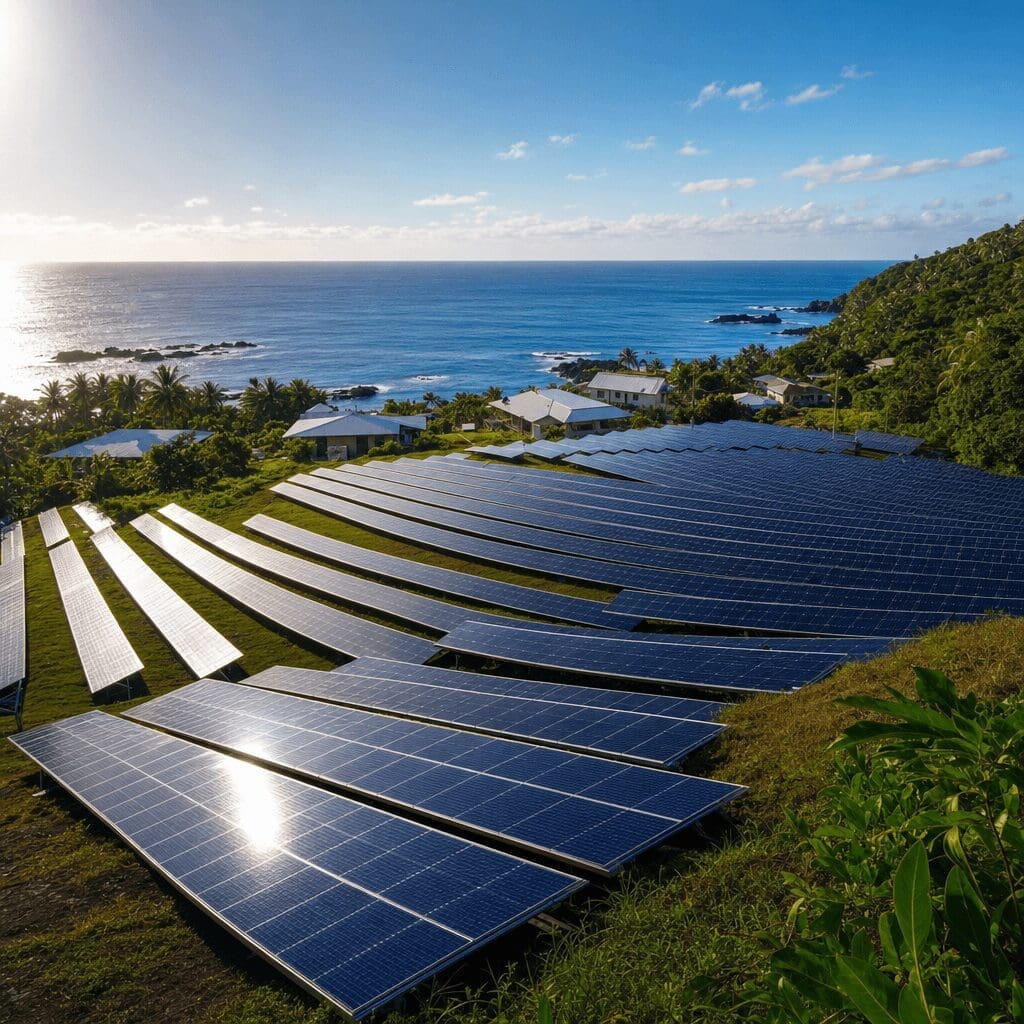
On a small island in the South Pacific, about 6,500 kilometres from the California coast, something quietly extraordinary happened in late 2016. The island of Ta’ū, home to roughly 600 people spread across three villages in American Samoa, had for generations depended on supply ships for nearly everything, including the drums of diesel that kept the lights on. When those ships were delayed by weather or mechanical trouble, which happened regularly, the island would have to ration power.
For many in the West, this is hard to imagine. Electricity available only in the mornings and afternoons, with candles used after dark to light homes. “I recall a time they weren’t able to get the boat out here for two months,” one resident remembered. “It’s hard to live not knowing what’s going to happen.”
Then, in November 2016, the diesel generators fell silent, forever. A 1.4 MW solar array and 60 Tesla Powerpack batteries, capable of storing enough energy to power the island for three full days without a single ray of sunshine, had taken over. The entire island’s energy generation shifted from 100% diesel to 100% solar with the flip of a switch. No diesel, no gas, no grid connection to anywhere else. Just sunlight, stored in batteries, flowing to homes and a hospital and a school on one of the most remote inhabited islands on earth.
Ta’ū is not a thought experiment. It is not a pilot program hedged with asterisks. It works, and it has kept working for nearly a decade.
But Ta’ū has 600 residents and near-constant tropical sun. Scale that model up to a city, a province, or a country, with its factories and data centres and cold winter nights, and the questions multiply quickly. Is 100% solar, wind, and battery storage genuinely achievable at scale, or is Ta’ū just a beautiful outlier? What would it actually take? And why, every time someone claims it’s impossible, does real world experience prove them wrong?
Moving the Goalposts
For as long as wind and solar have been part of the conversation about electricity, a familiar argument has existed that the grid can only handle so much intermittent generation before it becomes unstable. The threshold has shifted over time, but the pattern remains. Draw a line, predict disruption, watch it pass uneventfully, then draw a new line.
The concern itself was grounded in real physics. Conventional power plants, like coal, gas, hydroelectric, and nuclear, rely on large spinning turbines that provide inertia, a kind of built-in shock absorber that helps stabilize frequency when supply and demand shift. Wind and solar, by contrast, connect through inverters and don’t inherently provide that same stabilizing force. Early on, this led to a widely held view that once renewables reached roughly 10–20% of total generation, grid reliability would begin to degrade.
But in practice, that threshold never materialized as a hard limit. As countries began pushing past it, they didn’t encounter instability so much as they adapted. Denmark moved steadily beyond 20%, 30%, and 40% wind penetration by strengthening interconnections and modernizing grid operations, eventually reaching 88% renewable electricity by 2024. Germany followed a similar path, nearly quadrupling its renewable share since 2006 while improving reliability. Even Texas saw grid performance improve as wind capacity expanded, driven by better forecasting and system management.
What changed wasn’t the physics, but the systems around it. Grid operators developed more sophisticated tools, markets evolved, and technologies improved. The ceiling that once seemed fixed began to look more like a moving target.
None of this suggests the engineering challenges are trivial. They are real, and increasingly complex at higher levels of penetration. But the pattern is difficult to ignore. Each predicted breaking point has turned out not to be a wall, but a waypoint. That doesn’t prove there is no limit, but it does suggest that any new claim about where that limit lies should be treated with careful scrutiny.
What “100% Renewable” Actually Means
When a country, city, or company announces it has reached “100% renewable energy,” the intuitive picture is a grid running entirely on wind and solar, with no fossil backup and no imported power. In reality, that’s almost never what the headline means.
Many of the most celebrated examples rely on resources that aren’t widely replicable. Iceland, Costa Rica, Norway, and Paraguay all run near- or fully renewable grids, but they largely achieve this through hydropower and geothermal. These are impressive achievements, to be sure, but they depend on geographic advantages that most regions simply don’t have.
Even in places dominated by wind and solar, the definition of “100%” is often more about accounting than physics. Most claims are made on an annual net basis. In other words, over a year, an entity buys enough renewable energy (directly or via certificates) to match its total consumption. But at any given hour, the electricity actually being used may still come from fossil sources, with the “renewable” portion balanced elsewhere on the grid, or at a different time entirely.
That gap has led to a push for a stricter standard. In 2020, Google argued that annual matching obscures real-world emissions and introduced the concept of 24/7 carbon-free energy. Under this model, every hour of consumption must be matched by carbon-free generation, on the same grid, at the same time. This approach eliminates the ability to offset fossil-heavy periods with surplus renewable production from other places or seasons. Since then, other major companies and policymakers have begun moving in the same direction, reflecting a broader recognition that timing and location matter as much as totals.
That stricter framing is the one that matters here, as we explore whether a grid can run on solar, wind, and battery storage alone, without major disruptions – no hydropower, no geothermal, no reliance on imports, and no gaps masked by annual accounting. It’s a much harder question than whether “100% renewable” has been achieved on paper.
And while the answer to that softer question has long been yes, the harder one is where the real test begins.
How Close Has Anyone Actually Come?
Under that strict definition, the field narrows quickly. The usual success stories, which focus on hydro-rich countries and annual accounting claims, fall away, leaving only a handful of real-world systems operating at or near the edge. Taken together, they reveal what the final stretch of the problem actually looks like.
American Samoa: the only true full-time example
The small island of Ta’ū operates year-round on solar and battery storage alone, with no diesel backup or grid imports. Its system, about 1.4 MW of solar paired with 6 MWh of battery storage, works because the conditions are unusually favorable. Strong, consistent sunlight near the equator and a modest, stable load with no heavy industry or winter peaks. Since 2016, it has reliably displaced diesel generation and ended dependence on fuel shipments.
But Ta’ū is better understood as ‘proof of possibility’ than ‘proof of scalability’. Its success translates well to similar tropical microgrids, but not easily to larger systems with industrial demand or seasonal variability.
South Australia: the leading edge at scale
At the other end of the spectrum is South Australia, the most advanced large grid in the world on this path. Serving about 1.9 million people, it regularly reaches 100% wind and solar for periods of the day and met roughly 74% of total demand with renewables in 2024. A mix of wind farms, rooftop solar, grid-scale batteries, and technologies like synchronous condensers has allowed operators to push renewable penetration to levels once thought impractical.
Yet South Australia also shows where the limits currently lie. It remains interconnected with neighboring grids, imports power during prolonged low-renewable periods, and retains gas generation for stability. Its 2027 target is for net 100% renewables on an annual basis, but again, this is not continuous, fully islanded operation. On today’s infrastructure, it could not reliably run through extended low-wind, low-solar periods on its own.
El Hierro: a cautionary tale at the edge of the definition
A smaller but revealing case is El Hierro. Its wind-and-pumped-hydro system has achieved 100% renewable operation for weeks at a time, storing excess wind energy by pumping water uphill and releasing it later. But the island still relies on diesel backup, which supplies a meaningful share of annual electricity. The lesson here is that even with relatively cost-effective long-duration storage, bridging extended gaps in renewable generation remains difficult.
Honourable mentions
Other examples, like King Island in Tasmania or Tilos in Greece, demonstrate important pieces of the puzzle, but all retain some combination of backup generation, interconnection, or non-wind/solar resources. Each comes close, but none fully meets the strict bar.
The honest conclusion is this. Under a definition limited to solar, wind, and batteries, with no imports and no major disruptions, only Ta’ū has clearly crossed the line, and only at a very small scale. Everywhere else is still climbing the same curve, relying on at least one excluded support: hydro, geothermal, fossil backup, or external grids.
Which brings the real question into focus: if even the most advanced systems haven’t fully closed the gap, what exactly is making the last few percent so hard?
Where the Engineering Gets Hard
The technical challenge of running a grid entirely on solar, wind, and batteries isn’t a single problem. It unfolds across time, from fractions of a second to entire seasons. Each layer introduces a different constraint, and while all are solvable in isolation, the difficulty lies in solving them together.
The seconds problem: inertia and system strength
At the fastest timescale, which is in the realm of fractions of a second, the challenge is stability. Conventional power plants provide inertia through large spinning turbines that naturally resist sudden changes in grid frequency. Wind and solar, connected via inverters, don’t inherently supply this buffering effect. The response is to replicate it deliberately, using grid-forming inverters, synthetic inertia, and equipment such as synchronous condensers. South Australia has been a leading example, deploying synchronous condensers to increase how much of its grid can safely run on renewables at any instant. The key takeaway is that stability can be engineered, but it is no longer an automatic byproduct of the system.
The hours problem: the duck curve and daily storage
Shift to hours, and the problem becomes balancing daily cycles. As solar capacity grows, grids develop the “duck curve”. This results from excess power generation at midday and steep ramps in power demand in the evening as the sun sets. This is where lithium-ion batteries excel. Short-duration storage, which typically range from two to four hours, has become cost-effective and widely deployed. They are charged on midday excess solar and discharged in the evening to help meet peak demand. But success here creates a new dynamic. As solar scales, more midday energy is curtailed and prices can turn negative. So, while this means that reliability is no longer an issue, for asset owners and developers, economics become the challenge.
The days problem: dunkelflaute and long-duration storage
Beyond that lies the hardest layer: multi-day gaps in renewable generation. Events like Europe’s dunkelflaute, which are extended periods of low wind and solar, expose the limits of current systems. Lithium batteries, optimized for hours, become prohibitively expensive over days. Bridging these gaps requires either massive overbuilding, much longer-duration storage, or alternative dispatchable resources. Technologies like iron-air batteries, flow batteries, and green hydrogen are advancing quickly, but none are yet deployed at the scale needed to fully solve this problem.
The overbuild problem: how much extra generation it takes to be reliable
Which leads to the final constraint of overbuilding. To guarantee reliability without fossil backup, a solar-wind system must generate far more energy than it typically needs, ensuring enough supply during the worst conditions of the year. That implies large surpluses during good conditions, leading to energy that must either be curtailed or absorbed by flexible demand like hydrogen production or EV charging. Many studies find this overcapacity, rather than storage, becomes the dominant cost driver.
Taken together, the pattern is clear. None of these challenges is a dead end. Each has credible solutions already in use or close at hand. The difficulty is integrating them into a system that remains reliable every second of every day while the transition is still underway. The physics is demanding but manageable. The real challenge is orchestrating all the pieces at once.
Who Gets the Blame When the Grid Fails
Before turning to what it would actually take to reach a fully solar, wind, and battery-based grid, there is one more piece of context that matters, and that’s how we interpret grid failures. High-renewable systems do fail from time to time, as does every grid, but the early explanation of those failures often points in the wrong direction. That matters because policy responses depend on diagnosis, and misdiagnosis tends to produce expensive solutions to the wrong problem.
A few recent events illustrate the pattern.
Texas, February 2021: a fossil failure mistaken for a renewable one
In February 2021, a severe winter storm hit Texas, triggering a massive collapse across the ERCOT grid. Within hours, more than 30 GW of capacity was lost and millions of customers were left without power, in some cases for days. Early political commentary quickly focused on frozen wind turbines as the cause. That image became the dominant narrative in the first news cycle.
The official investigation told a different story. A joint report by FERC and NERC found that the largest share of outages came from natural gas, coal, and nuclear plants. Gas supply failures, frozen equipment, and wellhead issues accounted for much of the lost capacity, while wind contributed a smaller fraction. The core issue was not a renewable breakdown, but a system-wide failure to winterize generation and fuel infrastructure, despite prior warnings after an earlier cold event in 2011.
Iberia, April 2025: an inverter-era cascade, with contested causes
A similar dynamic played out in April 2025 in the Iberian Peninsula, when Spain and Portugal experienced a major blackout affecting tens of millions of people. Early commentary again focused on renewables, since solar output was high at the time of the event. But preliminary technical reports from European system operators point instead to a cascading sequence of grid disturbances and protection trips that propagated across the network.
The role of inverter-based generation is still being studied, particularly in the first seconds of the event, but the emerging picture is consistent with a multi-factor system failure rather than a single-cause “too much solar” explanation. Importantly, the official investigations are still ongoing, and early narratives remain provisional.
The pattern is older than these two events
The pattern extends further back. The 2019 UK blackout was initially linked to wind generation in public commentary, but investigations traced the trigger to a lightning strike and the subsequent loss of a gas plant, followed by a cascading frequency event involving both conventional and renewable sources. The 2020 California outages were widely attributed to solar’s evening ramp, but later analysis highlighted resource adequacy planning and market design failures as the primary drivers. And the 2016 South Australia blackout, often cited in similar debates, ultimately traced to storm damage on transmission infrastructure combined with protection settings that responded too aggressively.
Across these cases, a consistent theme emerges: early explanations tend to focus on whatever technology is most politically salient at the time, while later technical investigations usually find multiple interacting causes (system design, protection settings, weather events, and operational constraints) rather than a single dominant culprit.
This is not to say high-renewable grids are immune to failure. They introduce new engineering challenges, particularly around inertia, inverter behaviour, and system protection. Those challenges are real and require deliberate solutions. But the broader lesson is that grid failures are complex, and the first narrative is often the least accurate.
The systems that ultimately reach very high renewable penetration will not be the ones that avoid failure altogether. They will be the ones that learn to diagnose failure correctly—and respond to it with the right engineering tools rather than the most immediately intuitive explanation.
What It Would Actually Take
A jurisdiction aiming for 100% solar, wind, and batteries, under the strict definition used throughout this article, would be solving a problem no large grid has yet fully solved. But it would not be starting from scratch. Every core technical challenge already has known solutions, and in many cases those solutions are already deployed in fragments across the world. The crucial requirement is to assemble a full-stack system where each layer reinforces the others, and where policy and markets allow all parts to scale together.
Five ingredients matter most.
Geographic and resource advantage
First is geography. Some regions simply start with better conditions: strong wind, strong solar, and diversity between them. When wind tends to peak at night and solar at midday, and when weather patterns are only weakly correlated, the system needs less storage and less overbuild. South Australia is a good example, where coastal wind and inland solar complement each other. Grid size also matters. Larger interconnected regions can smooth weather variability across distance, while isolated systems must compensate with far more storage and spare capacity.
A portfolio of storage durations, not just lithium
Second is storage diversity. Lithium-ion batteries have enabled the current phase of grid transformation and are now highly cost-effective for short-duration needs like the daily “duck curve.” But they are not suited to multi-day or seasonal gaps. A fully renewable grid will require a portfolio spanning lithium for hours, lower-cost long-duration technologies like iron-air and flow batteries for multi-day events, and hydrogen-based systems for seasonal balancing. None of these is yet deployed at full required scale, but all are advancing in parallel.
Demand flexibility on a scale we have barely begun to use
Third is demand flexibility. Instead of forcing supply to meet demand at every moment, a high-renewable grid increasingly does the reverse. Electric vehicles can shift charging to periods of surplus generation, industrial electrolysers can ramp hydrogen production when power is cheap, and buildings can pre-heat or pre-cool using thermal storage. The more demand can move in time, the less storage and overbuild the system needs overall. And in many cases, it is cheaper to shift demand than to expand supply-side buffering.
Deliberate overbuild and accepted curtailment
Fourth is deliberate overbuild. A reliable renewable system must routinely generate more energy than it immediately uses, accepting curtailment as a normal feature rather than a failure. This is a major departure from fossil-era thinking, where high capacity factors were the goal. In a solar-wind system, surplus energy is not wasted. It’s what guarantees supply during rare but critical low-generation periods, and it can often be absorbed by flexible demand. Major system studies, including Princeton’s Net-Zero America and Australia’s AEMO modeling, consistently converge on this conclusion: overcapacity is not optional, but structural.
Grid-forming inverters and the operator capability to use them
Finally, there is the grid’s operating capability. As synchronous generators are displaced, stability must be recreated through synchronous condensers and grid-forming inverters that actively support voltage and frequency. But hardware alone is not enough. Operators must also develop the experience, tools, and control systems to manage an inverter-dominated grid in real time. This is as much an institutional transition as a technological one.
Taken together, these five elements outline a coherent pathway. None is speculative in isolation, and all are already visible in partial form. The challenge is that a fully functioning system requires all of them to mature simultaneously. The physics is manageable. The integration is the hard part.