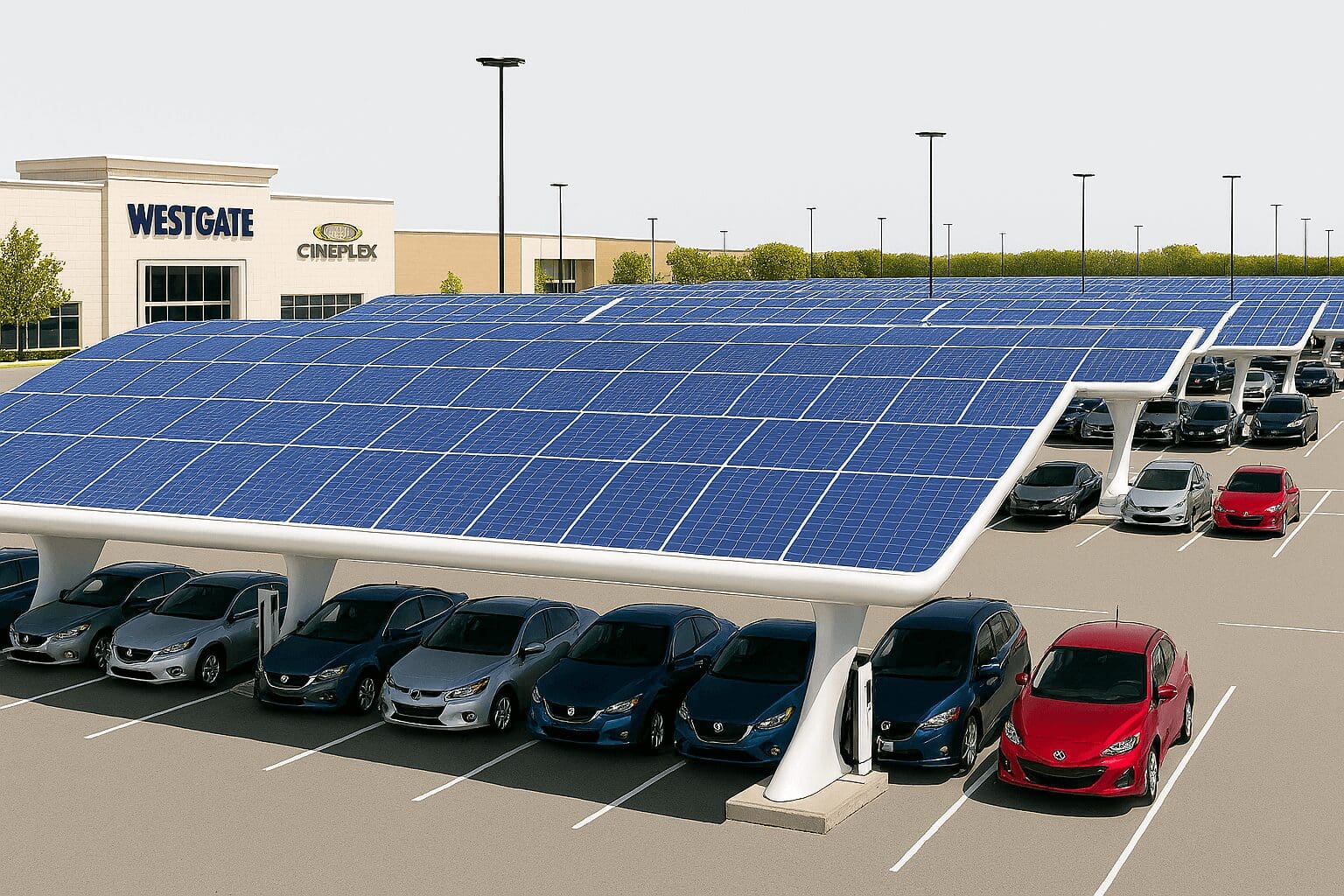
Imagine this. On a warm, sun-drenched afternoon, you head out to do some shopping at your local mall. As you turn into the bustling parking lot, something extraordinary catches your eye. Above each row of vehicles stretches a sleek, modern canopy, its surface a mosaic of solar panels that shimmer softly in the sunlight.
You pull into a space beneath the canopy and immediately notice that the panels overhead provide perfect shade for your vehicle. There’s no need to set up your own sunshade or crack open windows to keep the interior from becoming unbearably hot. As you step out of your vehicle, the soft hum of electricity fills the air; almost imperceptible, yet oddly calming. It’s the sound of energy captured from the sun, flowing seamlessly through the panels, into storage batteries, and out to the grid, powering homes, schools, and perhaps even the very mall you’re visiting.
The lot feels like a miniature oasis of shade and light. Overhead, the panels are mounted on graceful beams that are modular, elegant, and yet undeniably functional. More than just infrastructure, they are a statement that your community has chosen sustainability without sacrificing convenience.
As you browse the aisles, the sky outside begins to shift, growing heavy and dark. Thunder rumbles in the distance, followed by the sudden crack of hailstones pelting down. Instinctively, your mind jumps to your vehicle, conjuring images of dented panels, spiderwebbed windows, and the expensive repairs that are sure to follow. But just as quickly, your worrying subsides as you remember the solar canopy above your vehicle, shielding it from the intense storm.
As you step out of the store, your vehicle remains cool and protected, and your mind hums with admiration for the elegance of the system you’ve just experienced. This isn’t just a parking lot, it’s a living example of what’s possible when engineering, sustainability, and foresight converge. You imagine every mall, school, and municipal lot in your community transformed this way, a network of clean energy silently powering businesses and homes while providing comfort and protection to the everyday routines of life.
Is it utopia? Yes. But it’s also entirely achievable with today’s technology.
Reimagining Municipal Assets
Across Canada, municipalities are stewards of vast, underutilized real estate known as open-air parking lots. Parking lots at recreation centres, libraries, arenas, schools, and transit hubs sit idle for most of the day, absorbing sunshine and contributing to the urban heat island effect. What if these asphalt expanses could be reimagined as productive energy assets that generate revenue, enhance resilience, and symbolize community leadership?
Solar canopies represent exactly that opportunity. They turn conventional parking lots into decentralized power plants, generating electricity exactly where it’s needed. Coupled with battery storage and EV charging, these spaces evolve further into micro energy hubs that strengthen local grids and support community services during outages or emergencies.
For municipalities, solar canopies reveal an untapped opportunity: turning already-developed land into clean energy generation stations. By repurposing already disturbed land, developers can bypass many of the hurdles associated with greenfield development. Parking lots typically already have zoning approvals, existing infrastructure, and stormwater management systems in place, eliminating the need for costly environmental assessments or land-use reclassification.
Construction access is straightforward, with paved surfaces and utility connections readily available, reducing logistical complexity and labor costs. Additionally, these locations often sit near population centers, minimizing transmission losses and enabling direct energy use for facilities like malls, schools, or municipal buildings. The result is a dramatically accelerated timeline for deployment, lower upfront investment, and a more politically palatable path to clean energy, especially in communities wary of disrupting untouched landscapes.
With a few modifications, a basic parking lot can be retrofitted to harvest the sun’s energy without requiring new land use or disrupting existing community spaces. It’s an elegant form of densification that utilizes the same footprint to deliver multiple layers of public value.
The benefits extend well beyond clean power:
- Protection and comfort for residents and visitors, shielding vehicles and people from heat, hail, and snow.
- Reduced maintenance costs, as shaded pavement lasts longer and requires fewer repairs.
- Revenue potential through energy savings, power purchase agreements, or leasing arrangements.
- Enhanced public image, positioning the municipality as an innovator and leader in the energy transition.
Open-air parking lots provide the perfect canvas for highly visible solar installations that double as public amenities. And these opportunities aren’t just pie-in-the-sky fantasies. Municipalities around the world are already showing what’s possible. From recreation centres in Ontario to transit hubs in California and community campuses in Europe, solar canopies are transforming once-overlooked parking areas into productive, revenue-generating infrastructure. These community landmarks also function as visible symbols of adaptation and civic progress, quietly reshaping how cities produce, use, and think about energy.
What’s more, every municipal parking lot has the potential to evolve from a cost centre into a climate solution, providing shelter, generating clean power, and showcasing the innovation and forward-thinking that modern communities need.
Unlocking the Solar Potential of Parking Lots
Across cities and towns, parking lots stretch for millions of square meters, often overlooked as mere asphalt. In a city like Toronto alone, there are over 7,000 open-air parking lots with 80 or more spaces, each exceeding 1,500 square meters. Just one of these parking lots could reasonably host around 750 solar panels, assuming standard panel dimensions and spacing. This setup could generate approximately 300,000 kilowatt-hours (kWh) of electricity annually, enough to power 25–30 average Canadian homes for a year.
The potential is staggering. Even modest solar canopies over a single lot can produce enough electricity to power nearby public facilities, transit stations, or community hubs. Multiply that across hundreds, or even thousands of municipal and commercial lots, and the cumulative impact on energy generation, emissions reductions, and resilience becomes significant.
Beyond the numbers, these spaces are highly flexible. Canopies can be tailored to fit a range of lot sizes, orientations, and uses. They can integrate EV charging stations, battery storage, and smart energy management systems, making each lot a miniature hub of energy efficiency and innovation. What was once an underutilized stretch of asphalt can become a productive, multi-functional asset, quietly generating clean power while serving everyday community needs.
Perhaps most compelling is the scale: parking lots are everywhere, from schools and hospitals to shopping centres and municipal complexes. Taken together, they offer a network of solar generation that can complement larger utility-scale projects, accelerate local decarbonization, and demonstrate that energy innovation doesn’t always require new land.
How PV Canopies Work
At its core, a solar canopy is elegantly simple. Photovoltaic (PV) panels mounted above a parking lot capture sunlight and convert it into electricity. The panels are made of semiconductor materials (often silicon) that generate a flow of electrons when exposed to light, producing direct current (DC) electricity. This DC electricity then flows through an inverter, which transforms it into alternating current (AC) suitable for powering buildings, streetlights, or feeding into the local grid.
The structure itself is designed to do more than just generate energy. Canopies provide shade and protection for vehicles and pedestrians, reduce heat accumulation on asphalt, and can even collect rainwater in some designs. The modularity of the systems means they can be customized to fit any lot, whether it’s a small community school parking area or a sprawling municipal transit hub.
Some solar canopies are also integrated with battery storage or smart energy management systems. This allows electricity to be stored for later use, helping manage peak demand or maintain power during grid outages. They can also be designed to support electric vehicle (EV) charging stations right in the lot.
Despite the technology behind them, PV canopies are surprisingly easy to install and maintain. The panels are durable, engineered to withstand snow, hail, and high winds, and require minimal upkeep. What’s more, advances in design and materials have made solar canopies both cost-effective and highly efficient, turning a simple shade structure into a productive energy hub.
And innovation doesn’t stop at the panels themselves. Creativity in the support structure opens up exciting possibilities, as well. For example, decommissioned wind turbine blades, which are difficult to recycle, could be repurposed as the mounting framework for solar panels. This approach not only reduces waste from the wind energy sector but also strengthens the circular economy, turning one form of renewable energy infrastructure into another.
Design and Engineering Considerations
While solar canopies may look sleek and simple, designing them requires careful engineering to ensure they are safe, durable, and efficient. One of the first considerations is structural load: the framework must support the weight of the panels, wiring, and any additional features like battery systems or EV charging stations, while also accounting for snow, ice, and occasional extreme weather events.
Drainage and water management are equally important. Canopies must be designed to channel rainwater and melting snow safely away from vehicles and pedestrians, preventing puddles, ice buildup, or erosion of the underlying pavement.
The tilt angle and orientation of the panels also play a critical role in energy efficiency. Panels need to be positioned to maximize sunlight exposure throughout the year while balancing aesthetic and spatial constraints of the parking lot. Adjustable or optimized tilt designs can boost energy generation without compromising structure or usability.
Wind resistance and durability are other key factors. Canopies must withstand gusts, storms, and potential debris while remaining structurally sound. Engineers often conduct simulations and adhere to local building codes to ensure long-term resilience.
Finally, creativity in materials and design can open new opportunities. Modular frameworks, repurposed materials such as decommissioned wind turbine blades, and integrated smart features can make each canopy both environmentally responsible and adaptable to site-specific needs.
The Economics: Cost, Payback, and Incentives
In addition to being environmentally compelling, solar canopies make financial sense when approached strategically. The costs of installation vary depending on canopy size, panel type, structural complexity, and additional features like battery storage or EV chargers. While upfront capital investment can be significant, the long-term benefits often outweigh initial expenditures, especially when factoring in energy savings, revenue streams, and avoided costs.
Payback periods can differ depending on the project scale and local energy prices, but in many cases, municipalities and commercial operators see a return on investment within 5–10 years. Beyond energy savings, shaded parking reduces pavement maintenance costs and can even extend the life of parked vehicles, creating additional indirect savings. Solar canopies also simplify winter operations by shielding individual stalls, eliminating the need for stall-by-stall snow clearing. Snow naturally accumulates in the driving lanes, allowing plows to move efficiently through the lot without weaving around parked cars, saving time, reducing labour costs, and improving safety for both drivers and maintenance crews.
Incentives and funding programs make the numbers even more attractive. Many federal, provincial, and municipal grants, rebates, and low-interest financing options exist specifically for renewable energy projects, energy efficiency upgrades, and EV infrastructure. Power purchase agreements (PPAs) or lease arrangements can also reduce upfront costs, allowing third-party investors to fund installation while the property owner benefits from clean electricity and operational savings.
Funding and Financing Pathways
While solar canopies offer clear economic and environmental benefits, financing can be a critical factor in bringing projects to life. Fortunately, a variety of public and private funding pathways exist to help municipalities, developers, and businesses turn parking lots into productive energy assets.
Federal Support
The Green Municipal Fund (GMF) provides grants and low-interest loans for projects that improve energy efficiency, reduce greenhouse gas emissions, and support sustainable community development. Similarly, Infrastructure Canada offers funding programs for energy and climate-focused infrastructure, helping cover upfront capital costs and accelerate implementation timelines.
Provincial Programs
Many provinces offer additional incentives, such as rebates, tax credits, or specialized financing for renewable energy installations and EV infrastructure. These programs can complement federal funding, helping to reduce payback periods and improve the overall financial feasibility of solar canopy projects.
Private Financing Options
Beyond public funding, municipalities and commercial property owners can leverage power purchase agreements (PPAs), leasing arrangements, or partnerships with energy service companies (ESCOs). In these models, a third-party investor funds the installation and maintenance of the canopy, while the property owner benefits from clean electricity and operational savings. This approach can eliminate or greatly reduce the need for upfront capital, making solar canopies accessible even for organizations with limited budgets.
By combining federal, provincial, and private financing mechanisms, solar canopy projects become not just feasible but financially strategic. These pathways reduce barriers, accelerate adoption, and help communities maximize the return on their sustainable infrastructure investments.
Building the Business Case
With funding and financing pathways in place, the next step is understanding the tangible value solar canopies deliver. By producing clean, on-site electricity, they reduce greenhouse gas (GHG) emissions and lower energy costs, while also providing long-term avoided costs such as reduced demand charges, lowered overall parking lot maintenance costs, and mitigation against energy price volatility.
Solar canopies also create local benefits, including job opportunities during installation and maintenance, enhanced community spaces through shaded parking, and improved public perception of organizations committed to clean energy leadership. When combined with the federal, provincial, and private financing options outlined previously, the business case for solar canopies becomes even more compelling: projects are not only feasible but financially strategic.
If you’re interested in exploring how a solar canopy could transform your parking lot into a productive, sustainable, and community-friendly asset, contact GreenKey Energy. Our team can guide you through design, financing, and implementation to turn this vision into reality.