In the sweltering heat of a Havana summer afternoon, lights flicker and die across entire neighborhoods, fans grind to a halt, and refrigerators fall silent. Families light candles or cluster around battery-powered radios as rolling blackouts stretch from hours into days, weeks, and beyond.
It would be easy to assume this is a scene from the 1960s, when the United States imposed an oil embargo on Cuba, cutting off exports and pressuring refiners to stop processing Soviet crude. But this is not history; this is happening in Cuba today.
In early January 2026, a U.S. military intervention in Venezuela ousted President Nicolás Maduro, Cuba’s longtime ally and supplier of heavily subsidized oil. Weeks later, President Donald Trump signed an executive order declaring Cuba a national security threat and authorizing tariffs and other penalties on any country that supplies or sells oil to the island. The result has been a de facto oil blockade.
The consequences have been immediate and severe. Roughly 95% of Cuba’s electricity is generated by thermal plants running on crude oil, fuel oil, and diesel. With peak power deficits approaching 2,000 MW, hospitals are increasingly dependent on backup generators, and international airlines have begun canceling flights, unable to reliably refuel on the island amid acute fuel shortages.
And yet, amid the darkness, a quiet transformation is underway.
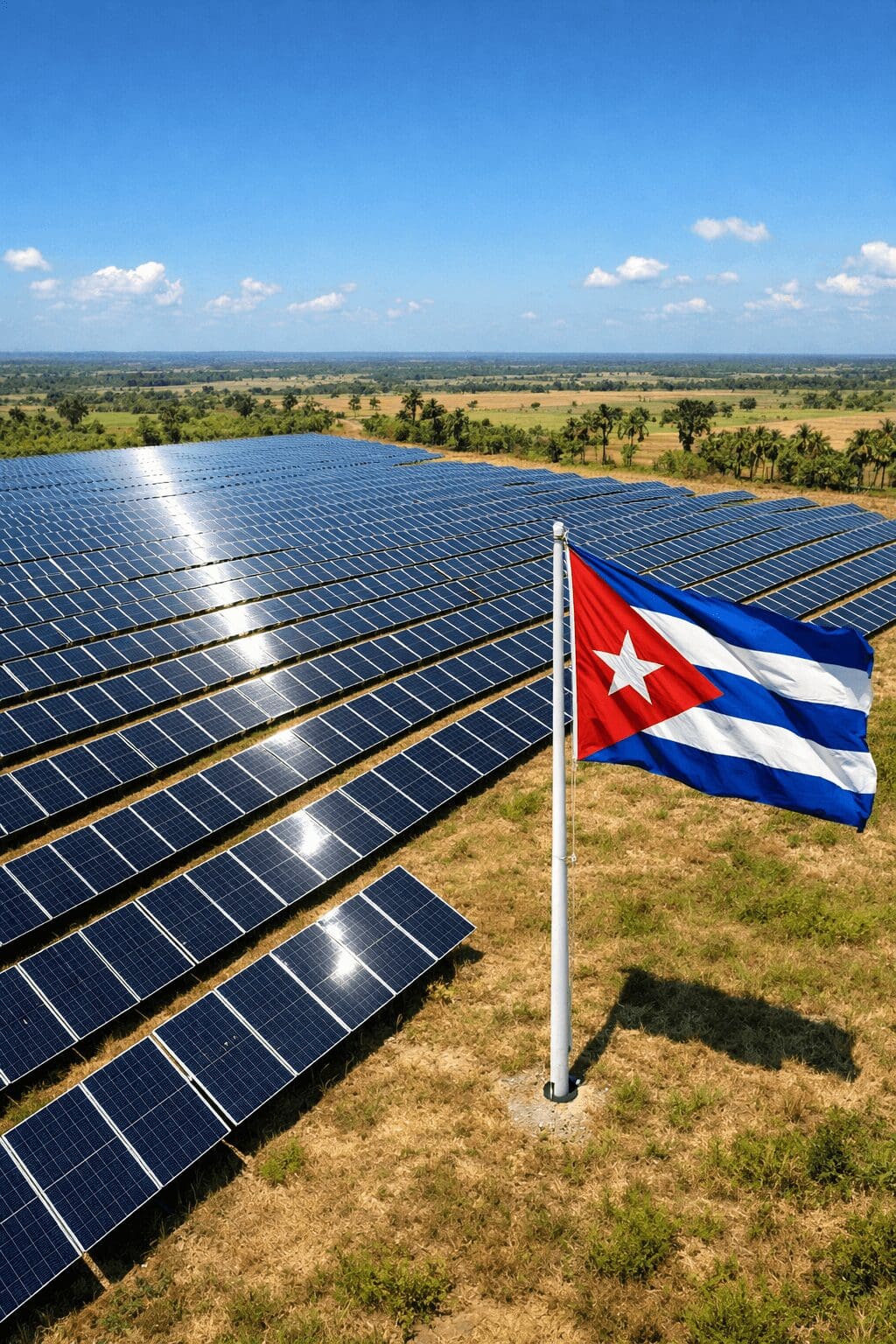
Across rural provinces and the outskirts of major cities, solar parks gleam under the bright Caribbean sun. In Sancti Spíritus, the Cabaiguán photovoltaic facility, which was constructed in a matter of months, is already delivering new clean power to the grid. Similar projects in Villa Clara, Ciego de Ávila, and elsewhere have pushed installed solar capacity beyond 1,000 MW in recent months, with government plans calling for 92 solar parks totaling 2,000 MW by 2028.
Biomass generation from sugarcane residues, small-scale wind projects, and community biodigesters are beginning to round out the mix, slowly chipping away at the island’s near-total dependence on imported fossil fuels.
Cuba’s push toward renewable energy isn’t ideological; it’s born out of survival and sovereignty. This week, we’re exploring Cuba’s energy independence story as a compelling case study in rapid transitions driven by necessity.
Historical Foundations and Early Seeds of Sustainability
The Special Period marked a profound turning point in Cuba’s history, beginning in the early 1990s following the collapse of the Soviet Union in 1991. For decades, Cuba had relied heavily on subsidized trade, oil, food imports, fertilizers, pesticides, and machinery from the Soviet Union and the Eastern Bloc. This support accounted for a massive portion of Cuba’s imports (around 85% in the late 1980s) and propped up its economy, including an industrialized, input-heavy agricultural sector focused on export monocultures like sugar.
The sudden loss of this lifeline triggered a severe economic crisis. Cuba’s GDP plummeted by about 35% between 1990 and 1993, imports fell by up to 80%, and oil supplies were drastically reduced, leading to widespread blackouts and fuel rationing.
This “wake-up call” forced rapid adaptation and laid early groundwork for more sustainable practices born out of necessity rather than ideology.
Organic Farming and Urban Agriculture as Energy-Saving Innovations
Deprived of chemical fertilizers, pesticides, and fuel for machinery, Cuba underwent what is often described as the world’s largest shift from conventional, high-input agriculture to organic and semi-organic methods Pre-crisis, Cuba used more pesticides per hectare than the United States; post-collapse, such inputs became unavailable.
To address food insecurity, especially in urban areas where 69% of the population lived, citizens and the government turned to urban agriculture. Vacant lots, rooftops, balconies, and backyards in cities like Havana were converted into productive gardens. The government supported this grassroots movement by legalizing private plots, creating the Department of Urban Agriculture in 1994, and establishing the National Group for Urban and Suburban Agriculture (GNAU) in 1998. Initiatives included organopónicos (raised-bed organic farms using compost and biofertilizers), community cooperatives, and policies redistributing state land via usufruct rights (e.g., the 1993 Third Agrarian Reform).
By the early 2000s, Havana alone had transformed tens of thousands of hectares into urban farms, producing over 50% of the city’s fruits and vegetables locally. This reduced energy demands for transport, cut reliance on imports, and promoted agroecological techniques like crop diversification, composting, and natural pest control. These principles became a model for sustainable, low-energy food systems worldwide.
Initial Steps Toward Renewables: Small-Scale Experiments in Solar and Biomass
Energy scarcity during the Special Period also spurred early interest in renewables to offset fossil fuel dependence. Cuba already derived some electricity from biomass (e.g., sugarcane bagasse, accounting for around 11% in the early 1990s), but the crisis accelerated diversification efforts.
A 1993 National Energy Sources Development Program prioritized efficiency and local renewables. Small-scale experiments included solar photovoltaic systems to electrify off-grid rural schools, health clinics, and social centers, with thousands of such installations being deployed in the 1990s.
The Modern Blockade and Fuel Dependencies
Cuba’s longstanding struggle with U.S. sanctions, which have been formally codified as a trade embargo since the early 1960s, has shifted dramatically in recent years from primarily economic measures to a more explicit energy blockade. Traditionally, the embargo restricted trade, financial transactions, and investment between the two countries, isolating Cuba from international credit markets and discouraging foreign companies from engaging with the island’s economy.
However, under the current U.S. administration, these pressures have intensified into targeted policies aimed at cutting off Cuba’s access to crucial fuel supplies. Washington has issued executive orders threatening tariffs on any nation that exports oil to Cuba, effectively deterring traditional energy partners and adding a new strategic layer to the sanctions regime. This expansion of the embargo into the energy domain directly exacerbates Cuba’s dependency on imported oil, a vulnerability Havana has long sought to reduce through renewable development.
Venezuela’s Waning Oil Lifeline and Global Market Volatility
For decades, Venezuela served as Cuba’s primary source of crude oil under highly preferential terms, often exporting tens of thousands of barrels per day in exchange for healthcare and professional services. This arrangement helped sustain Cuba’s energy-intensive sectors despite U.S. sanctions. Yet in recent years, Venezuela’s oil output has plummeted due to chronic underinvestment, sanctions on its own energy sector, and internal political instability.
Shipments to Cuba declined sharply, and as of late 2025, Havana reported that it had not received Venezuelan oil for several months, a blow that has severely strained electricity generation and transportation in the country. This disruption has been compounded by external geopolitical developments, most notably, U.S. military impositions on Venezuelan oil shipments and punitive measures against third-party suppliers, which have effectively severed Cuba’s remaining lifeline. As a result, the Cuban government has faced acute fuel shortages even as domestic production is unable to fill the gap.
Impacts of Sanctions and International Relations
In early 2026, the situation reached a critical juncture when U.S. policy effectively blocked Cuba’s access to imported fuel entirely. Under new U.S. directives, countries that previously supplied oil to Cuba, such as Mexico, have scaled back or halted shipments in the face of potential tariffs, while Venezuela’s lifeline remains severed amidst mounting diplomatic pressure. This has precipitated rolling blackouts, transportation breakdowns, and crises in essential services across the island. The Cuban government has responded with emergency measures, including prioritizing limited fuel for critical sectors and imposing workweek reductions to conserve energy.
Cuba’s Roadmap to 100% Renewables
Cuba’s renewable energy strategy is anchored by ambitious national targets set by the Ministry of Energy and Mines (MINEM). Despite long-standing dependence on imported fossil fuels, the government has committed to increasing the share of renewables in the national electricity mix from around 4% today to 24% by 2030, with an eventual aim toward total energy independence powered by domestic clean sources. This 2030 goal has been formalized through policy frameworks that emphasize solar, wind, biomass, and small-scale hydroelectric generation as pillars of the transition.
Recent strategic plans have even projected increasing renewable penetration to 17% by the end of 2026 as an intermediate milestone, pushing toward the broader 2030 objective. Long-term discussions among planners envision deeper adoption of clean energy technologies that could accelerate progress beyond these targets, particularly as storage solutions and grid modernization improve.
Cuba’s vision is to seek energy sovereignty, by building a more resilient, self-reliant energy system, thereby reducing its future exposure to fuel price shocks and geopolitical pressure. Although “100 % renewables” remains a longer-term aspiration rather than an official near-term target, strategists see the current roadmap as setting the foundational architecture for such a future.
Key Policies and Investments
Achieving these goals requires both robust policy signals and large-scale investments. The Cuban government has launched a suite of initiatives to accelerate renewable deployment, the most visible of which is the national rollout of solar parks. The plan calls for the installation of dozens of photovoltaic parks capable of delivering over 1,000 MW of solar capacity, with a longer-term program targeting up to 92 parks totaling 2,000 MW by 2028. Many of these are supported through cooperation agreements with international partners, especially China, which is supplying technology, panels, and financing.
In parallel, wind farms and biomass generation, especially using residues from the sugarcane industry, are being integrated into the energy mix. Official renewable planning documents reference capacities across these sectors as part of the 2030 transition, with biomass playing a key role in balancing variable solar and wind generation.
To strengthen the framework for private and institutional participation in renewables, Cuba has also codified incentives and mandates through laws and decrees. These regulations require large energy consumers to invest in renewable sources or connect to national solar infrastructure, aiming to decentralize generation and reduce overall dependence on imported fuels.
By tying these policies to broader economic goals, the government is trying to both modernize the grid and mobilize capital, both domestic and foreign, necessary for what is arguably Cuba’s most significant energy overhaul in decades.
Challenges on the Path
Cuba’s energy infrastructure faces structural limitations that complicate the transition to a fully renewable system. Much of the national grid was built decades ago, designed for centralized fossil-fuel generation rather than distributed solar or wind production. Aging transformers, outdated transmission lines, and limited capacity for integrating intermittent renewable sources create significant technical bottlenecks. Frequent outages, voltage fluctuations, and equipment failures underscore the urgency for modernization.
Maintenance challenges are exacerbated by the scarcity of spare parts and the difficulty of importing specialized components under ongoing U.S. sanctions. Even well-planned renewable projects can be delayed or underutilized when grid integration is insufficient, highlighting the need for a dual focus on generation and network resilience.
Financial Barriers
Economic constraints present another major hurdle. Cuba’s limited access to international capital markets and banking channels, a legacy of decades-long sanctions, restricts the flow of investment into renewable energy infrastructure. While bilateral agreements with countries like China or Russia provide targeted support, these arrangements are often insufficient to meet the scale of Cuba’s ambitions.
Private investors remain hesitant due to regulatory complexity, perceived political risk, and the potential for sanctions exposure. At the same time, the high upfront costs of solar parks, wind farms, and biomass facilities place a heavy burden on national budgets, slowing project implementation and innovation scaling. This financial bottleneck reinforces Cuba’s need for cost-effective, locally manufactured solutions, while simultaneously limiting rapid expansion.
Climate and Environmental Risks
Even with technological and financial solutions in place, Cuba’s geography makes it highly vulnerable to climate risks. Hurricanes regularly strike the island, damaging energy infrastructure, disrupting supply chains, and displacing communities. The increasing intensity of storms due to global climate change poses ongoing threats to both centralized grids and decentralized renewable systems.
Additionally, natural resource scarcity, including water for hydropower and biomass production, limits consistent energy generation. Prolonged droughts, saltwater intrusion into freshwater supplies, and soil degradation can reduce the effectiveness of renewable installations, especially in rural and agricultural areas. These environmental pressures require flexible system designs, resilient materials, and robust disaster preparedness strategies.
What Cuba’s Story Teaches the World About Rapid Transitions
Cuba’s pursuit of renewable energy demonstrates how constraints can catalyze innovation. Facing decades of sanctions, fuel shortages, and limited access to international finance, Cuban engineers, communities, and policymakers were compelled to devise creative, low-cost solutions tailored to local conditions. From locally manufactured solar panels to small-scale biogas digesters, these innovations show that necessity can accelerate technological adaptation and promote resilience in ways that conventional, resource-rich pathways often overlook.
Cuba’s experience underscores a broader lesson for nations concerned about economic or geopolitical pressures and interested in seeking energy independence: adversity can stimulate ingenuity, foster self-reliance, and accelerate the adoption of clean energy solutions when coupled with strategic policy support.
Scalable Models for Developing Nations
Another key takeaway is the effectiveness of decentralized, community-driven energy systems. Rural electrification initiatives, cooperative solar projects, and localized biomass networks highlight the potential of distributed energy generation to improve access, enhance resilience, and reduce dependency on centralized fossil-fuel infrastructure.
For developing nations, this model offers a scalable blueprint. Investing in renewable technologies that communities can own, operate, and maintain empowers local stakeholders while ensuring energy security. Moreover, combining decentralized solutions with workforce training creates a virtuous cycle, building both technical capacity and societal buy-in for sustainable energy practices.
Implications for Geopolitics
Cuba’s transition also illustrates the geopolitical dimension of renewable energy. By reducing reliance on imported oil, the country strengthens its sovereignty, buffers itself from external pressures, and mitigates exposure to global fuel price shocks. In a broader sense, renewable energy becomes not just an environmental imperative but a strategic tool, giving smaller nations leverage in international affairs and enhancing resilience against sanctions or supply disruptions.
This lesson resonates globally. As energy systems decarbonize, nations can achieve both climate goals and strategic autonomy, particularly those historically constrained by economic or geopolitical dependence. Cuba’s story exemplifies how energy independence and sustainability can be pursued simultaneously, offering a compelling model for other nations navigating complex international environments.
Cuba’s Renewable Future and Call to Action
Cuba’s energy transition story is a remarkable example of resilience and ingenuity in the face of adversity. Decades of economic sanctions, fuel scarcity, and infrastructure limitations could have stifled progress, yet the nation has turned these challenges into a catalyst for innovation. By investing in solar, wind, and biomass technologies, harnessing local manufacturing, and mobilizing communities, Cuba has demonstrated that even under severe constraints, meaningful renewable energy adoption is possible. The crisis has been transformed into an opportunity to reimagine energy production and self-sufficiency.
Pathways to True 100% Renewables
Cuba’s roadmap to a fully renewable energy system remains ambitious but increasingly attainable. Achieving the 2030 target of 24% renewable penetration is a critical milestone, yet the ultimate vision extends further. Cuba seeks to be a self-reliant, resilient, and entirely renewable energy infrastructure capable of powering every home, farm, and industry on the island. Realizing this vision will require continued technological innovation, policy support, community engagement, and investment in human capital, particularly in rural areas where decentralized energy systems can have transformative impacts.
Inspiring Global Energy Independence
Beyond national borders, Cuba’s experience offers lessons for the world. It illustrates how necessity can drive creativity, how decentralized systems empower communities, and how renewables can serve as tools for geopolitical and economic sovereignty. As countries around the globe seek to reduce carbon emissions, enhance resilience, and secure energy independence, Cuba stands as a beacon of hope, showing that even nations facing severe constraints can carve a path toward sustainable, self-sufficient, and equitable energy futures.
Cuba’s journey is not only a story of national ambition but also a call to action: that innovation, perseverance, and collaboration can make the dream of a cleaner, more autonomous energy future a reality anywhere in the world.