I found my way to this week’s topic by an unexpected route. A Sydney tabloid recently ran a story questioning why an Australian content creator named Sarah Aubrey had visited Snowy 2.0, the enormous pumped hydro project under construction in the Snowy Mountains, and produced a series of videos about it. The implication was that she must have been handsomely paid to say nice things. Her response was refreshingly mundane: seven days of work, a prop plane from Wagga Wagga, and a fee that worked out to roughly $44 an hour.
What the paper achieved, at least in my case, was the exact opposite of what it presumably intended. I hadn’t been thinking about Snowy 2.0, or pumped hydro for that matter, at all. After reading the story, I spent the next week reading everything I could find about it.
There’s a name for this: the Streisand effect. Coined after Barbra Streisand’s unsuccessful 2003 attempt to suppress a photograph of her Malibu home, it describes the paradox in which trying to bury information only draws more attention to it.
And the more I read about Snowy 2.0, the more a question closer to home began to nag at me. Australia is betting A$12 billion on pumped hydro as the backbone of its energy transition. Canada holds roughly a fifth of the world’s fresh water, has greater elevation changes than almost anyone, and seven decades of world-class hydroelectric engineering. Yet we have built exactly one pumped storage facility in our history, and it was completed in 1957.
Is that a gap we should be closing, or a technology whose moment has already passed? That’s the question this piece sets out to answer.
The oldest battery we keep forgetting
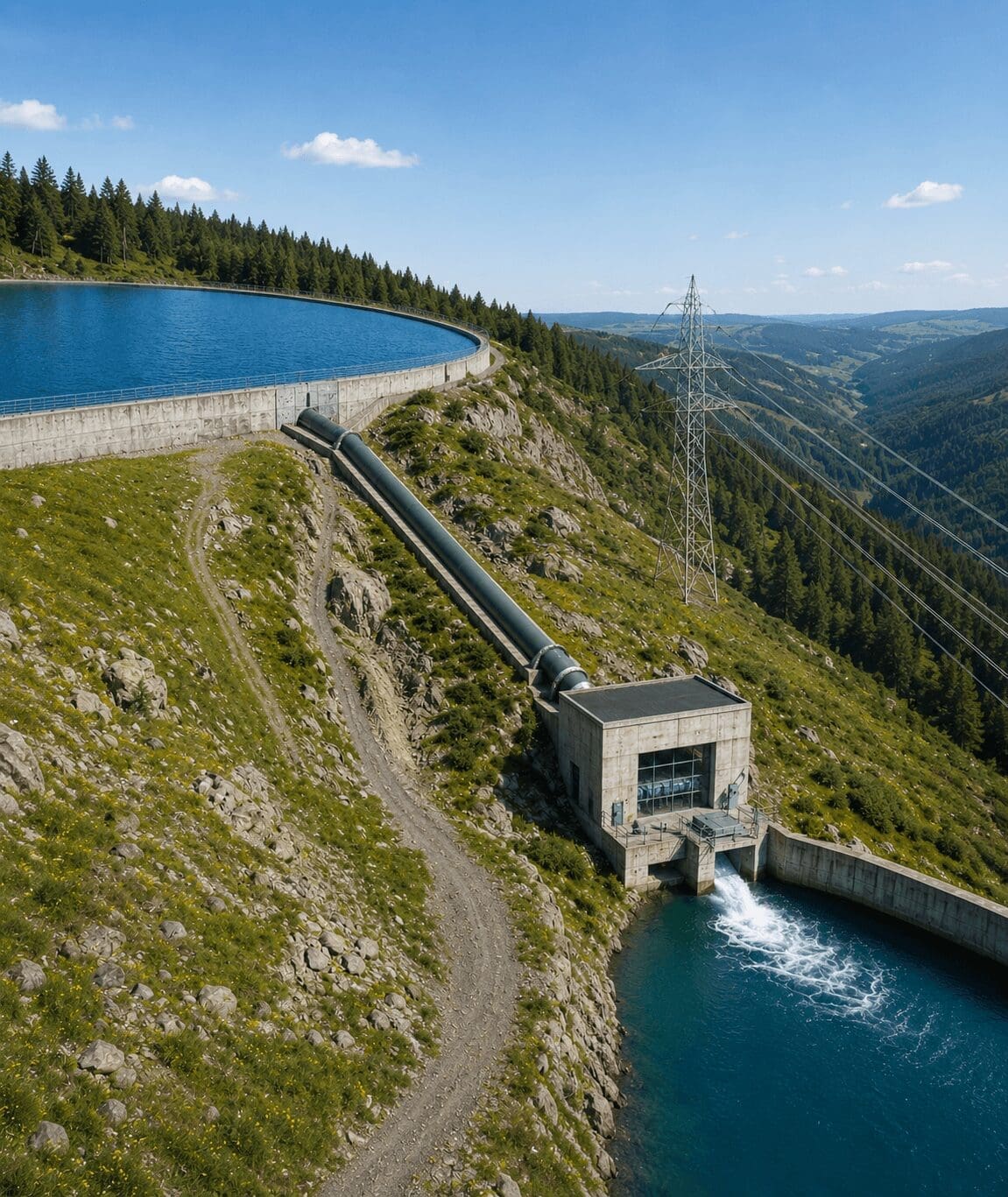
The concept of pumped hydro is almost embarrassingly simple. Take two reservoirs at different elevations. When electricity is cheap and plentiful, use it to pump water from the lower reservoir to the upper one. When the grid needs power, let the water fall back down through turbines. That is the whole idea. Energy in, energy stored as water sitting at altitude, energy out on demand.
It is worth being precise about what that makes it. A pumped hydro facility is a battery. Not a metaphorical battery or a battery-like thing, but a device that absorbs electrical energy, holds it, and returns it later, which is the entire job description. The chemistry is just different. A lithium-ion cell stores energy in the arrangement of ions; a pumped hydro plant stores it in the position of water. Gravity does the work a cathode does. And because water is cheap and hills are large, this particular battery can be built at a scale no chemistry has yet approached.
None of this is new. The first pumped storage plants were operating in the Alps in the 1890s, and the technology has been a quiet workhorse of grids ever since. Globally, capacity passed 200 gigawatts in what the International Hydropower Association called the year of the water battery. Grid batteries have now caught up on that measure, at over 220 gigawatts and climbing fast. But power is only half a battery’s specification; the other half is how much energy it holds. Measured that way, pumped hydro stores roughly 9,000 gigawatt-hours worldwide, against about 600 gigawatt-hours for every grid battery on Earth combined: more than ninety per cent of the world’s stored electricity, accumulated a century before anyone had heard of a gigafactory.
What has changed is why it matters. The original business case was built around inflexible thermal plants, which is a story I will come back to. The modern case is built around wind and solar, and around a specific limit of the batteries everyone talks about. Lithium-ion is superb at storing energy for a few hours and responding in milliseconds, and its reach keeps stretching; Australia’s first eight-hour battery reached full operation this May, and lithium projects are now winning tenders that were designed with more exotic long-duration technologies in mind. What lithium-ion remains poorly suited to, at least economically, is storing energy for days. A grid running heavily on renewables needs both, because its hardest test is not the evening peak. It is the calm, overcast week in January.
The physics, measured in mountains
To see how the machine works, and what it takes to build one, Snowy 2.0 is the best worked example on the planet right now.
The physics fits in one line. The energy stored in lifted water is its mass, times gravity, times the height you lift it. Lift one cubic metre of water, which weighs a tonne, up 100 metres and you have banked about a quarter of a kilowatt-hour. That sounds feeble, and for small quantities it is. The trick is that both terms scale magnificently. Make the height 700 metres and each cubic metre stores nearly two kilowatt-hours. Make the volume a lake, and you have a battery measured in weeks.
That is precisely what Snowy 2.0 does. The project connects two existing reservoirs in New South Wales, Tantangara at the top and Talbingo at the bottom, separated by about 700 metres of vertical drop, through 27 kilometres of tunnels bored through the mountains. At the midpoint, deep underground, sits a power station with reversible pump-turbines, machines that run in one direction as pumps and in the other as generators. When the grid is flooded with cheap solar at midday, Snowy 2.0 will pump water uphill. When the sun sets, or when a windless week settles over southeastern Australia, it will generate up to 2,200 megawatts for as long as the upper reservoir holds out.
And that is the number that separates this machine from everything else on the grid. Snowy 2.0’s storage capacity is roughly 350,000 megawatt-hours, enough to run at full output for about a week. The largest battery farms in the world today store around 3,000 megawatt-hours. One tunnel-and-lake system holds about a hundred times more energy than the biggest chemical battery ever built. When people say pumped hydro is a massive battery, this is what massive means.
The physics also explains the costs, and it is worth being honest about them here because they will reappear when we get to Canada. Water is cheap and gravity is free, but the container is not. Snowy 2.0 was announced in 2017 at an estimated two billion Australian dollars. The revised cost to complete is twelve billion, with first power expected in late 2027 and full commercial operation targeted for December 2028. A tunnel boring machine named Florence spent months stuck in soft ground and became a national punchline. Anyone who has read Bent Flyvbjerg and Dan Gardner’s How Big Things Get Done knows this pattern; in their database of project outcomes, megaprojects that involve boring through geology sit near the top of the cost-overrun league tables, and the planning fallacy does not spare water batteries. Construction is now more than 70 per cent complete and delivery rates have nearly doubled over two years, but the overrun is the part of the story the project’s critics reach for, and on the raw numbers they are not wrong to.
One more number, because it’s part of the full picture. Pumped hydro gives back roughly 75 to 80 per cent of the energy you put in (known as round-trip efficiency); friction and pumping losses claim the rest, and Snowy 2.0’s unusually long tunnels will push it toward the low end of that range. Lithium-ion does better, at 85 to 90 per cent. Efficiency is a real advantage for batteries. Duration, scale, and an operating life measured in generations are the advantages for pumped hydro.
The country that stopped at one
Canada generates about sixty per cent of its electricity from falling water. We built some of the largest hydro complexes on Earth. And our entire national pumped storage fleet is the Sir Adam Beck Pump Generating Station at Niagara Falls, 174 megawatts, commissioned in 1957. We have not completed another one since.
The easy answer is that we simply neglected the technology. But the reality of the situation is far more interesting, and it is a pattern regular readers will recognise. We have not built any additional pumped hydro since 1957 because the grid we had did not need it. The great reservoir systems of Québec, British Columbia, Manitoba, and Labrador are themselves storage on a colossal scale. When you hold back water behind a dam, you are banking energy exactly as a pumped hydro plant does; you simply let nature do the pumping, one snowmelt at a time. A hydro-dominant grid with big reservoirs gets most of the flexibility benefits of pumped storage for free, and for half a century that logic held. It was correct for the grid of the time.
The question is whether it is still correct for the grid we are about to build, and here the ground is shifting in three ways at once. Canada’s electricity production is forecast to grow from roughly 600 terawatt-hours today to 1,300 terawatt-hours by 2050, a doubling that sits at the centre of the federal Powering Canada Strong strategy and its trillion-dollar buildout. Much of the new supply will be wind and solar, which need storage in a way our legacy fleet never did. And the provinces where demand and renewables are growing fastest, Alberta chief among them, are precisely the ones without the great reservoirs. The conditions that made pumped storage unnecessary are the conditions that are ending.
Nor is geography the constraint. A 2023 assessment prepared for WaterPower Canada by Stantec, working with the Australian National University’s global atlas team, identified more than 8,000 gigawatts of pumped storage potential across nearly 1,200 Canadian sites, concentrated in British Columbia, Québec, and Newfoundland and Labrador. Treat that number the way you would treat any resource estimate, as a ceiling rather than a plan; it is roughly fifty times our entire installed generating capacity, and we will never build more than a sliver of it. But it settles one question decisively. If Canada builds little pumped storage in the coming decades, it will not be because we lacked the hills or the water.
What it would take to build one here
So what stands between the atlas and an operating plant? Three things, on the evidence of the projects now in motion. A site, a revenue model, and a decade of patience.
The sites are the encouraging part, because after a seventy-year pause there are serious proposals on the table. The largest is the Ontario Pumped Storage Project at Meaford on Georgian Bay, where TC Energy is proposing a 1,000 megawatt facility storing about 10,600 megawatt-hours, co-developed with the Saugeen Ojibway Nation as a genuine equity partner rather than a late-stage consultee. Ontario has committed up to $285 million in pre-development funding, and the project entered the federal Impact Assessment process this past March. In eastern Ontario, Northland Power and Ontario Power Generation are advancing the Marmora project, 400 megawatts built around a flooded iron-mine pit. The logic is elegant on a grid like Ontario’s. The province’s nuclear fleet produces a genuine overnight surplus, and both projects would soak it up and return that same cheap nighttime power into the evening peak.
On grids with more solar, the same machine runs on a different clock. There the opportunity is the midday price trough, absorbing low-cost solar that would otherwise be curtailed, switched off for lack of takers, and shifting it into the hours when demand is highest. The western Canadian example is the Canyon Creek project near Hinton, Alberta, 75 megawatts with up to 37 hours of storage on the site of a decommissioned coal mine, with its Alberta Utilities Commission generation approvals already in hand. In Demand Goes Looking for the Sun I wrote about teaching demand to chase cheap power; pumped hydro is the other half of that answer, teaching cheap power to wait for demand.
The revenue model is the hard part, and it deserves to be stated plainly. Nobody finances a billion-dollar machine with an eighty-year life on merchant electricity prices alone. Northland has said publicly that Marmora will not proceed without a long-term contract, and Ontario’s system operator concluded in 2022 that the pumped storage proposals then on its desk did not offer sufficient value under its financial models, a finding now being updated. Alberta’s energy-only market poses the sharpest version of the problem. Canyon Creek’s 37 hours of duration is exactly what a renewables-heavy Alberta grid will want during a multi-day winter lull, and there is no mechanism in today’s market that pays for the 37th hour. If governments want long-duration storage, and the demand forecasts say they will, procurement will have to learn to value duration and not just capacity. That is a design task, not a physics problem.
The patience is the part Snowy teaches. These are ten-year builds involving tunnels, geology, and first-of-a-kind risk in any given jurisdiction. Reference-class forecasting says to expect overruns and plan for them honestly, rather than announcing the cheapest imaginable number and spending a decade apologising for it. The right lesson from Snowy 2.0 is not that pumped hydro was a mistake. It is that the gap between the announced cost and the delivered cost is where public trust goes to die, and Canadian proponents have the luxury of learning that from someone else’s project.
The honest ledger
In every technology piece I write, I do my best to put data over dogma, so let me lay out the downsides of pumped hydro.
The first is land, and the answer depends heavily on the type of project. The old model, called open-loop, connects to a natural river system the way Sir Adam Beck draws on the Niagara River, and it carries the familiar ecological baggage of river hydro. The modern model, called closed-loop, uses two artificial or repurposed reservoirs off-river, filled once and then cycled indefinitely with modest top-ups for evaporation. Nearly all of the 1,200 sites in the Canadian atlas are closed-loop candidates, and the physical footprint is smaller than intuition suggests, a pair of reservoirs of a few hundred hectares connected by buried tunnels. This is not nothing, and it does mean reshaping land somewhere. But natural features do most of the work; the atlas method searches for paired natural basins precisely so that builders sculpt terrain rather than manufacture it. And where a project touches settled landscapes or sensitive shorelines, local concerns deserve a serious hearing. At Meaford, residents have raised fair questions about construction impacts on their community and on Georgian Bay itself, and the federal impact assessment now underway is exactly the venue where those questions should be tested. Proponents earn trust by engaging with them seriously, not by dismissing them.
The second is competition. Battery costs keep falling, and any pumped hydro proposal must survive the comparison honestly rather than wish it away. Analysts are already benchmarking Ontario’s long-lead storage proposals against ever-cheaper batteries, and for applications out to eight hours the batteries now usually win, deployed in eighteen months on any brownfield lot. The pumped hydro case rests on what batteries cannot yet do economically, which is duration measured in days and an asset that outlives its financing by half a century. Sir Adam Beck is pushing seventy years old and still cycling daily. No chemical battery yet built will see thirty. These are complementary tools, and the grids that thrive will use both, but a developer who cannot say clearly why their site needs water rather than lithium has not finished their homework.
The third is time and capital concentration. A billion dollars committed to one site for ten years is a different risk animal from a hundred battery projects deployed incrementally, and boards are right to weigh that concentration. It is the oldest trade-off in infrastructure, and pretending it away serves nobody.
What else the water does
Set against that ledger are some benefits that rarely make the headline economics, and one of them deserves more attention in a country that is learning to think hard about water.
A pumped hydro reservoir is, unavoidably, a large volume of stored fresh water, and that volume has option value beyond electricity. Closed-loop reservoirs have been drawn on for wildfire suppression and emergency supply, and in drought-prone regions the pairing of energy storage with water security is starting to appear in project planning deliberately rather than incidentally. The trade-off is real and should be stated. Every cubic metre lent to drought relief is storage capacity lent away, so dual-use needs designing in from the start rather than promising after the fact. But in a West where both the grid and the watershed are under strain, infrastructure that can serve both is worth more than either use alone suggests.
The machines themselves bring a quieter benefit. A pumped hydro plant spins hundreds of tonnes of steel in synchrony with the grid, providing inertia, the stored rotational momentum that steadies grid frequency through disturbances. Inverter-based resources can now supply a synthetic version, and grid-forming inverters run commercially at scale in Great Britain and on island grids, so inertia is no longer the exclusive province of heavy rotating machines. Pumped hydro simply delivers it as a free by-product of every megawatt, alongside black start capability, the ability to restart a dead grid without external power, a service exactly as valuable as it sounds and needed on the very worst day the system ever has.
And the construction itself lands where Canada needs it, a decade of skilled work in rural and northern communities, in trades that our resource industries have spent generations building.
Second lives for old holes in the ground
Which brings me to the thread I find most compelling, and the one with the deepest Canadian resonance.
Look back at the project list. Marmora is a flooded iron-mine pit, 220 metres deep, abandoned since the 1970s. Canyon Creek is a decommissioned coal mine. And the proof the model works at full scale arrived just months ago in Queensland, where the Kidston project, the first pumped storage scheme anywhere built in an abandoned gold mine, entered Australia’s national electricity market in November, 250 megawatts and 2,000 megawatt-hours cycling through pits that last produced ore in 2001.
The engineering logic is straightforward once you see it. A pumped hydro project’s biggest costs are excavation and elevation change, and a mine is a hole somebody already paid to dig, frequently with roads, transmission, and a community of industrial workers nearby. The pit becomes the lower reservoir; a modest new pond on the surface becomes the upper one. Much of the land disturbance that counts against a greenfield project was absorbed decades ago.
I find the symbolism as compelling as the economics, and I say that as someone who spent years of his career in Fort McMurray. These sites are the physical record of the resource industries that built this country’s prosperity, and the people who worked them carried exactly the skills, heavy civil works, rotating equipment, water management, that their second lives will demand. Alberta alone holds an inventory of decommissioned mines and disturbed industrial land that most countries would need a century to accumulate. At GreenKey, one of our core philosophies is that the cheapest site is often the one industry has already prepared, and the transition goes faster when it builds on the resource economy’s foundations instead of alongside them.
The tabloid’s gift
So, back to the question the Streisand effect handed me. Should Canada be building pumped hydro?
The honest synthesis runs like this. The physics is settled and has been for a century; a lake at altitude is the biggest battery humans know how to build. The geography is absurdly generous, 1,200 candidate sites against the one plant we finished in 1957. The need is arriving on schedule, carried by a doubling grid and a renewables buildout that will eventually face its calm week in January. What is not settled is everything the electricity industry politely calls delivery. Markets that pay for capacity but not duration. Assessments that take longer than construction. Announced budgets that poison trust when geology disagrees. Whether Canada builds water batteries is not a technology question or even really a money question. It is a question of whether we can design the revenue frameworks, run the honest cost estimates, and hold community trust across a decade-long build. The components exist. The delivery is the hard part.
Which is, I suspect, the real lesson of Snowy 2.0, and even of the tabloid coverage that sent me down this rabbit hole (or maybe I should say water hole) in the first place. Scrutiny of megaprojects is not the enemy; projects that overrun by billions have earned the questions, and the transition is better for reporters who ask them. The enemy is the gap between promise and delivery that gives the questions their sting. Close that gap and the coverage takes care of itself. A country that learned to deliver oil sands megaprojects, LNG terminals, and some of the largest dams on Earth has every credential required to learn it again for water batteries. The water is waiting uphill from here.