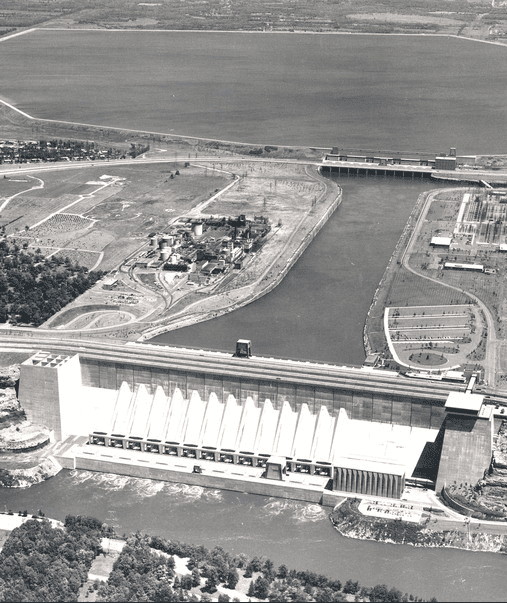
In 1957, on the terrace above the Niagara Gorge, Ontario Hydro switched on a machine unlike anything else in the country. At night, when the province slept and its generators ran into slack demand, the machine pumped water out of the hydro canal and up into a 750-acre reservoir whose walls had been piled up from the rock of the canal’s own excavation. By day, it let that water fall back through its turbines to help carry the peak. It was Canada’s first pumped storage plant. Sixty-nine years later it is still our only one, and it was quietly cycling water uphill again last night.
Here is what I cannot tell you about the Sir Adam Beck Pump Generating Station: what it cost. Not because the number is a secret, but because nobody bothered to keep it famous. Something is always said about the price of a new machine, and whatever was said in 1957 died with the people who said it. The cost was paid once, in dollars that no longer exist. The value is still being paid out, one night at a time, into its eighth decade.
I open there because of what happened last week.
The iron law and the two bad roads
My article on pumped hydro travelled all around the world, and the comments came back from three continents probing the same weak spot. The cost. Snowy 2.0 was announced at two billion Australian dollars; the official cost-to-complete now stands at twelve billion, and critics who fold in financing and transmission argue the true figure runs far higher. I spent much of the week in those threads, and the honest summary is that outsiders can no longer reconcile the official number with the critics’ numbers, which is itself a kind of verdict.
All of those challenges were fair. And behind all of them sits a harder question, the one Bent Flyvbjerg and Dan Gardner litigate throughout How Big Things Get Done: if Snowy 2.0 had been priced honestly at the start, would it ever have been approved?
It helps to know how rarely honest pricing happens. Flyvbjerg has spent his career assembling the world’s largest database of project outcomes, sixteen thousand projects across 136 countries on every continent except Antarctica, and the pattern he found is blunt enough that he calls it the iron law of megaprojects. Over budget, over time, under benefits, over and over again. In his data, fewer than one project in ten finishes on budget and on schedule, and only about half of one per cent deliver the budget, the schedule, and the promised benefits together.gether.
It is worth pausing on that third term, because it sounds like it sinks the argument I am about to make. It does not. Under benefits means under the promised benefits; the same optimism that lowballs the costs inflates the ridership, and both exaggerations are measured against the pitch, not against the decades that follow. Whether a machine ultimately earns its keep is a different question, answered on a much longer clock, and it is the question this essay is about.
Tunnels and dams sit near the top of the overrun tables. The generous explanation is the planning fallacy, our chronic inability to imagine the surprises geology has waiting. The less generous explanation is what Flyvbjerg calls strategic misrepresentation: price it low to win approval, and rely on momentum once the tunnel is half-dug, because nobody cancels a half-dug tunnel. The economist Albert Hirschman even offered a sympathetic version, the Hiding Hand, which holds that if we knew the true cost of great works in advance we would never attempt any of them, and the world would be poorer for our prudence.
Canadians should resist the urge to feel superior here, because we perfected this art early, and on the very terrace where my story opens. The 1957 pump station is the quiet middle child in a family of machines that share Adam Beck’s name at Niagara. The first and grandest of them, the Queenston–Chippawa development of 1917 to 1925, later renamed Sir Adam Beck No. 1, was estimated around $20 million and finished at $84 million in the dollars of the day. The overrun triggered a full provincial inquiry, the Gregory Commission, and a political storm that nearly broke Adam Beck himself. The commission catalogued the management failures, and then delivered a verdict that reads strangely a century on. It called the project a magnificent piece of engineering. The plant passed its hundredth birthday in 2022, and it is running as I write this. It was, in every particular, the Snowy 2.0 of the 1920s, down to the inquiry and the headlines. Today it is named for the man the overrun nearly destroyed.
So the lowball road is well travelled, and we know where it leads. You eventually get the asset, late and over budget, wrapped in a crisis of public trust. What about the other road? What happens when the honest numbers arrive?
Calgary, where I live, has been finding out for forty years. The Green Line was first envisioned in 1983, two years after our original CTrain opened. In 2015 the full vision was pitched: 46 kilometres of light rail for $4.5 billion. Then the estimates started getting honest. By 2017 it was 20 kilometres for $4.65 billion. By 2020, a redesign at $5.5 billion. By mid-2024, with projections passing $7 billion, council cut the first phase to roughly 14 kilometres at $6.2 billion, and that September the province withdrew its funding entirely over the downtown alignment, bringing the whole project within sight of death before an agreement revived it. Shovels finally broke ground in June 2025, forty-two years after the idea was born, on less than a third of the railway, for more than the price of the whole thing. I make no comment here on any of the alignment decisions, which remain contested; I cite my hometown only for what it teaches about estimating. Honesty arrived mid-project, and it did not kill the Green Line. It shrank it by two-thirds and nearly killed it anyway.
There is the trap, then. Price the dream and you build a trust crisis with an asset attached. Price the truth and you deliver a fraction of the ambition, a generation late, if the project survives the reckoning at all. If those are the only two roads, the argument against building big things wins by default.
Everyone is arguing about the numerator
But notice something about every fight I have just described. The scandal at Queenston in 1922, the tabloid pile-on over Snowy, the decade of Green Line arithmetic, every one of them is an argument about the top half of a fraction. Cost over what? That denominator almost never gets named, and it is doing all the work.
The instinctive denominator is short. A budget cycle, an election, at most the decade of construction itself. Divide a twelve-billion-dollar machine by ten angry years and the number looks obscene. But infrastructure does not live on that clock. A grid battery earns for fifteen or twenty years before its cells age out. A gas plant runs for thirty or forty. A nuclear station, with licence extensions, sixty to eighty. And the civil works of hydro, the dams, tunnels and reservoirs, run a century or more, taking new turbines the way a good building takes new tenants. Sir Adam Beck No. 1 is one hundred and four. The oldest stations of the original Snowy Scheme, the postwar wonder that employed a hundred thousand people from thirty countries, have been earning since the 1950s. Divide by a century and the overrun that horrifies a decade becomes a rounding error. Call it the century asset, because we are going to need a name for it.
And persistence is only half of what the long denominator buys, because century assets do not merely endure. They compound. This is the part of the ledger almost nobody counts. The American nuclear fleet’s capacity factor, the share of the year a plant actually runs at full output, climbed from the mid-fifty per cent range in the early 1980s to above ninety per cent today, which is arithmetically like discovering half again as much fleet hiding inside the fleet, without pouring a single new foundation.
Wind farms built 20 to 25 years ago are now being repowered with modern turbines on their original sites, increasing output by leveraging transmission infrastructure and grid interconnections that were built and paid for decades ago. Hydro operators swap turbine runners and gain efficiency inside hundred-year-old concrete; Beck’s own pump reservoir began a major refurbishment in 2016, and Snowy 2.0 was uprated from 2,000 to 2,200 megawatts partway through construction. The pattern is general. The civil works, the site, and the grid connection form a platform, and technology keeps improving inside the platform, on capital our grandparents already paid for. Past dollars keep unlocking present energy. That is not sentiment; it is cash flow, arriving every operating year.
None of it is free, and I should say so. Century assets demand periodic capital (Beck’s pump reservoir refurbishment alone runs to tens of millions), and they carry century liabilities, from eventual decommissioning to hydrology that a changing climate is quietly rewriting. But a refurbishment that buys another forty years on civil works long since paid for is precisely the kind of spending the short denominator misprices. Longevity is not free. It is simply the best bargain on the menu.
The same Niagara terrace that gave us the 1920s scandal also supplies the modern proof that the trap has an exit. In 2005, Ontario Power Generation launched the Niagara Tunnel Project, boring a new ten-kilometre water supply to the Beck stations with the largest hard-rock tunnel boring machine in the world, nicknamed Big Becky in honour of Sir Adam Beck. The Queenston Shale did to Big Becky what mountain geology later did to Snowy’s machines.
Approved at $985 million, the tunnel finished around $1.5 billion, four years late against the original schedule, and I want to be careful not to launder that. The overrun was real and ratepayers paid it.
The redemption is narrower, and it is the part nobody remembers. Re-baselined honestly in 2009, with the geology finally on the table, the project finished a hundred million dollars under that honest budget and nine months ahead of that honest schedule, in service in 2013, feeding extra water to turbines built generations before it. Honest budgets are survivable. They can even be beaten. What is not survivable, on the evidence of a full century at one site, is pretending.
That, and not resignation, is Flyvbjerg’s actual prescription. Estimate from the reference class, the real track record of projects like yours, before political commitment rather than after. State ranges, not points. Stage the commitment so honesty has somewhere to land. And here is where the two halves of this essay meet, because the century denominator is not a licence to lowball. It is the opposite. It is the only argument strong enough to let a project face its honest cost and still proceed. Would Snowy 2.0 have been approved at an honest twelve billion? Judged against an election cycle, almost certainly not. Judged the way its predecessor now judges itself, as the down payment on a hundred years of firming a renewable grid, it becomes a serious question rather than a scandal.
Which raises the real stakes. What happens to a country that loses the nerve to make that judgment?
The world without the builders
In The World Without Us, Alan Weisman ran a famous thought experiment: remove humanity overnight and watch how quickly our infrastructure crumbles without us. It is worth running his experiment in reverse. Keep the people. Remove the infrastructure.
Subtract, one by one, what the postwar generation left us. No Beck complex above the gorge, no Hydro-Québec dams filling the winter night, no St. Lawrence Seaway, no TransCanada pipeline, no national airports, no 1981 CTrain for a young city on the prairie. The Canada of this morning, the one that ran your kettle and this laptop, dissolves item by item into something poorer, colder, and smaller. Every convenience of the counterfactual morning traces back to a ledger some previous generation chose to sign, usually over furious argument about the numerator.
The uncomfortable part is that we do not have to imagine this counterfactual very hard, because in one dimension we live inside it. Canada never built the east-west electrical spine the builders’ era assumed would come next. Our provinces trade electricity north-south with American neighbours far more easily than with each other; the interties between provincial grids remain thin, and a country with some of the cheapest clean power on Earth in one province and gas-fired scarcity pricing next door has, in effect, thirteen electricity systems wearing one flag. The world without the builders is not a hypothetical. East to west, it is roughly the map we have.
The grid the machines might leave behind
Now run Weisman’s experiment forward from 2026, and ask what the next generation will find when they play this game about us. The candidates for this era’s great bequest are not obvious, because the biggest capital flood of our time is pouring into the shortest-lived asset in industrial history.
The hyperscalers are spending hundreds of billions of dollars a year on artificial intelligence data centres, and the computing hardware that dominates those budgets has an effective life of three to five years before newer chips strand it. Data centres already draw roughly one and a half per cent of the world’s electricity, and the race for power has grown desperate enough that the industry’s favourite phrase is now “bring your own power”: gas turbines behind the fence, small modular reactors someday, private energy islands owing nothing to anyone.
I don’t buy the island story, and I have been saying so to anyone who will listen. A data centre’s entire business is uptime measured to five nines, 99.999 per cent availability, and the cheapest reliability machine ever invented is not a private turbine fleet. It is the grid: a continent-wide pool of shared redundancy refined over a century.
However a campus powers itself on a sunny Tuesday, it will want the grid standing behind it on the worst night of the winter. Sooner or later it will apply to connect, for backup only, of course.
And the moment a gigawatt-class load applies to connect, the system around it has to grow: new transmission and distribution lines, substations, transformers, and additional storage. Utilities are forced to expand staffing and supply chains while interconnection queues finally move. Every one of those upgrades is a thirty-to-hundred-year asset. Under traditional rate-base regulation, the costs are recovered from all customers over decades.
That possibility changes the ledger of this bubble entirely. Consider how earlier manias settled their accounts. The railway bubbles left rails, century assets that still carry freight. The dot-com bust left an ocean of dark fibre, bought from bankruptcy for cents on the dollar, that quietly carried the next twenty years of the internet.
The AI cycle’s chips will evaporate on their five-year clock whether the bet succeeds or fails; that much is certain. What is not yet decided is where the rest of the spend lands. Routed through private islands, this mania would be the first in industrial history to leave behind mostly empty shelves. Routed through the grid, it leaves wires, substations, transformers and storage: century assets demanded at a speed no government would dare propose, but built because hyperscaler demand forces utilities to act. The costs are ultimately socialized across ratepayers through the rate base.
If the AI era’s appetite ends up triggering the lines we have declined for generations to build ourselves, perhaps even the east-west spine this country has never had, then a bust would strand the chips and leave the country wired.
And wires are not indifferent to the country they cross. A transmission corridor built to feed a data centre passes farms, towns and First Nations on its way, and capacity built for one customer becomes service for everyone along the line. Canada still has remote and Indigenous communities generating their light with trucked diesel, and rural feeders too thin for a modern farm or a new business, largely because no single load ever justified the wire. A gigawatt customer justifies the wire.
We even have the model for doing this properly: Wataynikaneyap Power, the Indigenous-owned transmission line in northwestern Ontario, connected more than a dozen remote First Nations that had spent generations on diesel, with the Nations holding majority equity in the asset itself rather than a courtesy seat at the consultation table. Route the boom’s corridors deliberately, and the AI era could end up finishing electrification work this country has deferred for half a century.
And that is when the interesting question begins, because a country left holding surplus delivery capacity, the poles, wires, substations and headroom to move power wherever it is wanted, does not simply sit on it. Economists call this the rebound effect, and they usually say it as a warning. William Stanley Jevons noticed in 1865 that more efficient steam engines made Britain burn more coal, not less; give people better access to energy and they find more to do with it.
Run the warning in reverse, though, and it reads as a promise. When power became abundant at Niagara a century ago, industries nobody had planned for, electrochemical plants, abrasives, aluminum, moved in to drink it. Québec’s cheap hydro built one of the world’s great aluminum industries. The engineers of 1957 never imagined a data centre, and the surplus found its uses anyway.
Cheap, abundant energy is the one input that has never once gone unused, and the inventions worth having are, by definition, the ones we cannot yet name. A generation that inherits an overbuilt, interconnected, storage-rich grid will not thank us for our restraint. It will fill it, with industries that today sound as improbable as a computer the size of a city once did.
There is one catch, and it is a design catch, not a fate. Collective payment cuts both ways. Absent reform, the boom’s grid buildout lands substantially on ordinary power bills, and if the load then departs on its five-year clock, ratepayers are left carrying forty-year assets alone — a fine bequest for the grandchildren, purchased with a rough decade for the grandparents.
So the bequest only lands well if the boom is steered through shared infrastructure: connection frameworks that welcome the load instead of stalling it, tariffs and rate structures that ensure the new demand pays its fair share of the upgrades it triggers, and siting that pulls campuses toward renewable corridors and, ideally, along the routes an east-west grid would want anyway.
Regulators across North America are already fighting over exactly this. Ohio approved a first-of-its-kind data-centre tariff last summer requiring large campuses to pay for at least 85 per cent of their contracted capacity whether they use it or not. Virginia has moved hyperscale loads into their own rate class to keep their costs from drifting onto households. And here in Alberta, the system operator capped interim data-centre connections at 1,200 megawatts after requests arrived for more than sixteen gigawatts, a queue thirteen times deeper than the door.
The patient capital for the century assets exists too, and a remarkable share of it is Canadian; our pension funds are among the world’s great buyers of long-lived infrastructure, currently buying other countries’ grandchildren their shade for want of revenue certainty at home. With impatient demand at the front door and patient capital waiting at the back, the grid of the next century could be financed effectively. The design is the missing piece. The capital never was.
And what about the quiet conductors the boom might leave behind, wires carrying a whisper of what they were built for, the way the dot-com fibre went dark and waited? That story deserves an essay of its own, because it gets stranger the closer you look; consider this a down payment on it.
Planting for another age
There is a line people often reach for when discussing ideas like this: A society grows great when old men plant trees in whose shade they know they shall never sit. It is almost always presented as an ancient Greek proverb. It is not. That attribution appears only in the 1990s. The oldest traceable version is Roman. Writing in 44 BC, Cicero quoted the playwright Caecilius Statius: He plants trees for the benefit of another age. In an essay about honest accounting, it seems only fitting to account honestly for quotations. Besides, the authentic version is both older and, I think, better.
Three generations of builders have now worked the same terrace above the Niagara Gorge. The first gave us a scandal, an inquiry, and a machine that has outlived everyone who shouted about it by long enough to turn one hundred. The second gave us the quiet pump station whose price I cannot find, still trading night for day sixty-nine years on. The third gave us a stuck boring machine, an honest re-baseline, and a redemption delivered under budget. Scandal, silence, redemption, and through all of it the water never stopped falling. Every one of those projects was, in its moment, an argument about the numerator. Every one of them is now a denominator, quietly dividing its old controversies into insignificance, one operating year at a time.
The overruns were real. The critics were often right. Flyvbjerg’s prescription, honest budgets before commitment, deserves to be law. But the deepest error in our megaproject arguments is not on the cost side of the ledger at all. It is that we have stopped counting what the money buys when the asset outlives the argument. Someone in 1957 paid, in full and in forgotten dollars, for the shade Ontario sat in this morning. We should aspire to build the kind of infrastructure whose price becomes history, but whose value becomes inheritance.