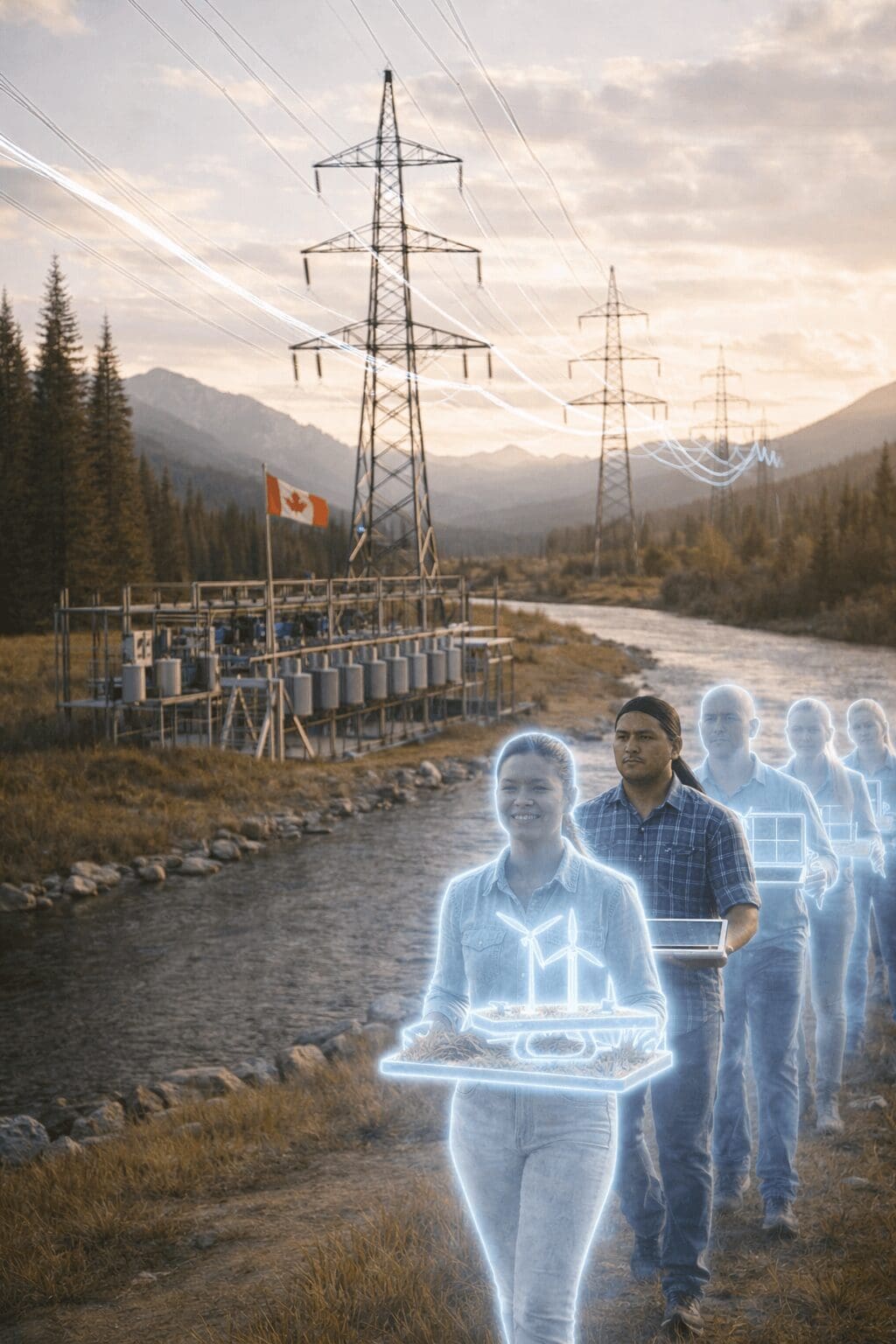
Canada is poised to lead the global shift to clean energy, with abundant renewable resources, ambitious net-zero targets, and a growing pipeline of wind, solar, and storage projects. Yet, despite strong developer interest and supportive policies, the pace of deployment often falls short. One of the most significant barriers lies not in technology or financing, but in the often-overlooked process of connecting new utility-scale generation to the grid.
Hidden hurdles such as backlogged queues, low early-commitment barriers that attract speculative applications, escalating costs from restudies, and limited interprovincial coordination are causing multi-year delays, driving up expenses, and slowing renewables deployment. While most developers act in good faith, systemic vulnerabilities can inadvertently allow immature or non-committed projects to clog the path for viable ones, hindering the timely integration of renewables amid rising demand from electrification and emerging sectors like data centers.
This week, we’re exploring how Canada’s provincial interconnection processes work, why they are straining under current pressures, and what reforms (both underway and optional) can clear the way forward. By understanding these challenges and embracing innovative solutions, including greater Indigenous leadership and leveraging international best practices, Canada can unlock its clean energy potential and build a more resilient grid for the future.
Everybody Get In Line
No matter what type of power generation asset is under development, a core requirement is to deliver electricity to the end user. Some projects achieve this directly, either through behind-the-meter installations that serve on-site loads or via independent islanded microgrids and off-grid mini-grids. However, the vast majority rely on the existing utility grid. In these grid-connected cases, where power is exported to or transmitted across the network, developers must obtain interconnection approval to secure the required grid capacity.
Grid Interconnection Explained
Grid interconnection is the process of physically linking electricity generators, such as utility-scale wind, solar, hydro, or other power plants, to the electrical grid, enabling them to inject power safely and reliably. In Canada, where electricity systems are provincially managed, this typically involves connecting new or expanded generation facilities to the transmission or distribution networks operated by provincial utilities or independent system operators. Developers initiate the process by submitting an interconnection application, which the system operator reviews through technical studies to assess impacts on grid reliability, feasibility, and any required upgrades.
Purpose of Interconnection Application
While it may appear that the grid interconnection application process is just a technical formality, it serves as a critical gateway designed to ensure the safe, reliable integration of new generation projects into the grid while maintaining stability. By rigorously evaluating proposed connections, these processes safeguard the grid’s overall performance while enabling the expansion of power supply to meet growing demand.
The main purposes are:
- Reliability and Stability: Assesses impacts on grid voltage, frequency, and fault tolerance to prevent blackouts or disruptions.
- Safe Integration: Allows new generators to inject power (e.g., from renewables) and enables excess energy export or net metering credits in some cases.
- Efficiency and Clean Energy Growth: Supports Canada’s net-zero goals by facilitating more wind/solar/hydro projects, sharing resources across regions, and reducing reliance on fossil fuels.
- Economic Benefits: Enables power trade, cost sharing for upgrades, and resilience against demand fluctuations or extreme weather.
Without proper interconnection, new projects can’t operate commercially.
The Interconnection Queue
In the context of grid interconnection for utility-scale projects, the term “interconnection queue” refers to the ordered list or waiting line of proposed projects that have formally applied to connect to the electricity grid.
It is called a queue because applications are typically processed in a first-come, first-served (sequential) order, much like a line or queue at a store. When a developer submits an interconnection request, it enters the queue at a specific position based on the submission date. The grid operator then studies and approves projects starting from the front of the queue.
This sequential approach is meant to ensure fair and methodical evaluation of grid impacts, upgrade needs, and cost allocations. However, with the surge in renewable projects, queues have become backlogged in many regions, leading to delays of several years.
In Canada, the terminology and exact process varies by province:
- Alberta’s AESO maintains a publicly visible “connection project list” (often referred to as a queue) and uses processes like cluster assessments to manage volume.
- Ontario’s IESO avoids calling it a strict “queue” and instead uses “committed projects” for assessments, but the concept of ordered processing still applies.
While the “queue” label is more prominently used in the US, the underlying idea of an ordered backlog of interconnection requests is common in Canada.
Interconnection Application Process
Provincial system operators or utilities manage applications, often involving queued or clustered assessments, impact studies, and approvals for grid upgrades. Federal involvement via the Canada Energy Regulator (CER) is limited to international power lines (e.g., cross-border interconnections) or interprovincial lines designated as federally regulated.
General Steps in Provincial Processes
While the specifics of grid interconnection vary across Canada’s provinces due to decentralized regulation, the overall approach shares a structured, multi-stage framework. This ensures thorough evaluation of technical, reliability, and economic impacts for utility-scale projects, such as large solar, wind, or hydro facilities.
Most provinces follow a similar high-level framework for utility-scale generation:
1. Pre-application/Inquiry: Contact the system operator/utility for feasibility info and site assessment.
2. Application Submission: Submit detailed technical data, deposits, and a formal request (e.g., System Access Service Request).
3. Studies/Assessments: System Impact Study (SIS), Facilities Study, and possibly Customer Impact Assessment to evaluate grid reliability, upgrades needed, and costs.
4. Approvals and Agreements: Obtain conditional approval, sign interconnection agreement, secure permits (environmental, land use), and fund/build upgrades.
5. Construction and Commissioning: Build facilities, test, energize, and achieve commercial operation.
This overall process usually takes between 2-5+ years, with many system operators using queues (first-come) or clusters (batched for efficiency) to handle backlogs, especially with renewables growth.
Interconnection Application Timing
Most developers of utility-scale renewable energy projects (e.g., large wind, solar, or storage facilities) in Canada file for grid interconnection relatively early in the project development lifecycle. This is typically done during the pre-construction or development phase, after site selection/control (land rights), preliminary feasibility studies, and resource assessments are completed, but well before financing, permitting completion, or construction begins.
This early timing is driven by several factors:
- Queue position and delays: In provinces with high volumes of applications (e.g., Alberta), entering the connection queue or cluster early secures a better position.
- Impact and cost revelation: Studies reveal required grid upgrades and costs early, allowing developers to assess viability and avoid sunk costs on unfeasible projects.
- Readiness requirements: Applications often require deposits, technical data, and evidence of project maturity (e.g. site control evidence).
- Procurement ties: In some cases, it’s aligned with power purchase agreement bids or provincial procurement processes.
Downside of Early Filing
While filing early for grid interconnection secures a favorable queue position and reveals potential costs/upgrades sooner, it carries several negative implications, particularly for developers and the broader system. These stem largely from the prevalence of speculative or immature projects entering queues prematurely.
For developers, early applications require upfront deposits, study fees, and milestones (e.g. site control evidence). It also means that capital is tied up in queued projects that could be redirected elsewhere, especially if waits extend 4–5+ years.
Projects filed too early often lack full permitting, detailed design drawings, or financing, which can lead to delays or cancellations as checkpoints are reached where proof of readiness is mandatory. If proof of readiness is unmet, projects are removed, forfeiting fees, triggering restudies that delay others, and contributing to overall backlogs.
For system operators, speculative early filings overwhelm the process, causing widespread delays. Viable projects get stuck behind non-viable ones, with restudies needed upon withdrawals. This can be a major issue, as historically 70–80% of queued projects withdraw.
Additionally, large backlogs of queued projects hinder renewables growth, slowing Canada’s net-zero progress despite strong consumer demand and developer interest.
A Potential Vulnerability in the System
In Canada, the initial filing costs for utility-scale grid interconnection applications (e.g., for large renewable projects) remain relatively modest compared to subsequent study fees, deposits, and potential upgrade expenses, which can run into millions of dollars.
This low barrier to entry, combined with the structure of renewable project development, can inadvertently encourage a high volume of early-stage applications. In renewables, pre-construction activities, such as securing land, permitting, design, and modeling, are relatively low-cost compared to the major capital outlay that occurs after Notice to Proceed (NTP), when construction begins. Industry estimates suggest that roughly 10% of total project capital is spent pre-NTP, with 90% committed post-NTP.
As a result, interconnection queues can fill with numerous proposals that demonstrate apparent momentum and commitment to clean energy development. Yet, if a project does not ultimately reach the final investment decision, the developer’s financial exposure remains limited to that initial 10% (or less, if deposits are refunded).
To illustrate, recent data shows Canada has around 217 utility-scale solar projects in operation (averaging ~18–20 MW per project) and 341 wind projects (averaging ~50–55 MW per project). Using approximate capital costs of $1.5–$2.0 million CAD per MW for solar and $2.0–$2.8 million CAD per MW for wind, pre-NTP development costs might average $3–$8 million CAD for a typical solar project and $10–$15 million CAD for wind. While these figures may seem substantial, they are manageable for larger entities with diversified portfolios.
This dynamic contributes to queue congestion and processing delays, as system operators are required to study large numbers of proposals that developers may have already abandoned. The problem has become so widespread that it has even earned an informal name: “zombie projects.” While most developers enter interconnection queues in good faith, current queue structures can (intentionally or not) allow under-committed projects to occupy capacity, slowing the timely integration of viable clean energy resources for everyone.
Other Challenges and Trends
In addition to the potential for a high degree of zombie projects in the queue, Canada’s push toward a cleaner, more electrified economy has intensified pressure on provincial grid interconnection processes. As renewable energy deployment accelerates alongside surging demand from electrification and high-load sectors like data centers, system operators face mounting backlogs, escalating costs, and the need for innovative management strategies.
Despite abundant complementary resources across regions, a persistent challenge in Canada’s electricity system is that significantly more power is traded with the United States than between provinces. Recent federal initiatives, including potential project designations and investment tax credits, seek to unlock new east–west transmission to enhance reliability and resource sharing. Yet interprovincial interties remain rare, facing structural barriers such as fragmented regulation, contested cost allocation, and a historically underbuilt national transmission network.
A vital and positive trend in Canada’s energy transition is the increasing leadership and equity participation of Indigenous communities in interconnection, transmission, and renewable projects. This aligns with federal priorities on reconciliation, UNDRIP implementation, and economic partnerships, helping to build trust, share benefits, and accelerate project approvals on traditional lands.
Addressing the Vulnerability
Low early-commitment costs, combined with other challenges, can result in interconnection queues crowded with proposals of varying viability, causing delays and inefficiencies for all participants. To address this, Canadian provinces have introduced targeted reforms aimed at strengthening project readiness and filtering out less mature applications earlier in the process. These measures are designed to ensure that queued projects are more likely to proceed to construction, benefiting system operators, ratepayers, and serious developers alike.
To achieve this, provinces are employing a combination of procedural and financial tools designed to raise the bar for entry and progression while maintaining fair access to the grid.
Key Approaches
- Stricter readiness milestones and gates: Requiring progressive proof of site control, permitting progress, technical data, and financial securities at defined stages.
- Clustering and batched processing: Grouping projects for collective studies to improve efficiency and shared cost allocation.
- Higher or escalating financial deposits: Increasing at-risk amounts to discourage non-committed entries.
- Early technical and maturity checks: Mandatory demonstrations upfront to weed out speculative proposals.
Provincial Reform Examples
- Alberta (AESO): The Cluster Assessment Process features gated stages with mandatory readiness requirements (e.g., financial securities, dynamic modeling, and Generator Utility Ownership Confirmation). Projects failing gates are cancelled, with penalties or forfeited fees for late withdrawals. This has helped manage high volumes of renewables and storage applications, with Cluster 3 intake updates ongoing into 2025–2026.
- British Columbia (BC Hydro): Transmission-level interconnections (>35 kV) under the Open Access Transmission Tariff require demonstrated site control (e.g., land leases or rights) early on, per revised criteria (updated November 2024). Escalating deposits for studies (often $50,000+ initially) are at risk upon withdrawal, supporting a queue-based system while prioritizing viable projects.
- Ontario (IESO): The Connection Assessment and Approval process emphasizes comprehensive upfront data and deposits for impact assessments. While not as heavily clustered, conditional approvals tie advancement to demonstrated compliance, helping maintain focus on committed projects amid growing demand.
- Québec (Hydro-Québec): For large generators, technical reviews and compliance with transmission standards are required early, with ministerial authorizations needed for projects ≥5 MW. This integrated approach ensures only well-prepared proposals advance in a hydro-dominated system.
These ongoing reforms, inspired in part by similar U.S. initiatives, aim to balance open access with system reliability. The ultimate goal is faster integration of genuine renewable projects while minimizing delays caused by backlog. Developers are strongly encouraged to review provincial guidelines closely, as requirements continue to tighten in response to rapid renewable growth.
Toward a More Efficient Future
As Canada continues to navigate the challenges of integrating vast amounts of renewable energy and managing surging demand, the provincial reforms underway represent significant progress in addressing queue backlogs and speculative applications.
However, with interconnection delays still hindering timely deployment, there is room to build on these efforts by drawing inspiration from best-in-class international examples. Jurisdictions around the world have pioneered innovative approaches that go beyond current Canadian practices, offering potential pathways to even faster, fairer, and more reliable grid connections.
Promising additional reforms include:
- Reuse of Existing or Underutilized Interconnection Points: Encourage development on brownfield sites (e.g., decommissioned mines, industrial facilities, or former power plants) with pre-existing substations and transmission capacity. This can bypass much of the queue, reduce studies, and cut timelines by years. While Canadian examples like BC’s SunMine demonstrate success, formalizing “surplus interconnection” rules, as done in several U.S. regions, could further incentivize repurposing underused assets.
- Prioritizing Indigenous Equity and Leadership in Projects: Mandate or incentivize meaningful Indigenous ownership, co-development, and governance in interconnection and transmission initiatives, building on successful models like the Wataynikaneyap Power Project (51% First Nations-owned) and Hydro One’s 50% equity offerings. This supports federal reconciliation goals under UNDRIP, enhances social license, and can expedite approvals by aligning with community priorities. This approach could also potentially integrate with proactive planning and fast-track pathways for mutual benefit.
- “Connect-and-Manage” or Energy-Only Interconnection Options: Allow projects to connect sooner with limited initial capacity or under curtailment risk (where excess power is reduced during constraints), while longer-term upgrades are planned. This accelerates viable projects without full upfront network reinforcements. The United Kingdom has successfully implemented “connect-and-manage” models, reducing wait times significantly, while Texas (ERCOT) in the U.S. uses a similar fast-track approach that has enabled quicker interconnections compared to other regions.
- Integration of Advanced Technologies in Studies: Mandate the evaluation of grid-enhancing technologies (GETs), such as dynamic line rating or advanced power flow controls, during impact assessments to unlock more capacity without major builds. The U.S. FERC Order 2023 (implemented across most regions by 2025) requires consideration of these tools, helping to lower costs and delays. While still early, initial data shows increased interconnection agreements and reduced backlogs.
- Fast-Track Pathways for Ready Projects: Prioritize “shovel-ready” developments with proven maturity (e.g., secured financing or offtake agreements) outside traditional queue order. California (CAISO) introduced a 2025 prioritization process that scores and advances high-readiness renewables and storage, aligning with state clean energy goals and clearing congestion faster.
- Automation and Digital Tools: Adopt AI-driven queue management, online portals, and standardized data requirements to minimize errors and speed reviews. Emerging U.S. initiatives (e.g., DOE-funded pilots) and Australian reforms under AEMO emphasize digital streamlining for both generation and large loads like data centers.
- Proactive Transmission Planning Coordination: Link interconnection more closely with anticipatory grid expansion to identify clusters of high-potential areas upfront. Global leaders like Australia’s National Electricity Market updates and U.S. regional operators combine this with clustering for efficiency.
Canada could benefit from exploring these through federal-provincial collaboration, perhaps via the Canada Energy Regulator or pan-Canadian forums, to harmonize standards where possible. By adopting elements of these proven models, tailored to our decentralized system, provinces can further accelerate the clean energy transition, lower costs for consumers, and ensure reliable power for growing needs.
A Call to Action
The reforms and innovations discussed hold immense potential, but their full realization depends on active participation from all stakeholders.
Developers: Engage early and deeply with provincial system operators (e.g., AESO, IESO, BC Hydro, or Hydro-Québec) through pre-application inquiries and public consultations. Prioritize high-maturity projects, explore underutilized interconnection points like brownfield sites, and advocate for streamlined processes that reward readiness and innovation.
Policymakers and Regulators: Build on current provincial efforts by exploring advanced reforms, such as formal “surplus interconnection” rules for existing points of interconnection (POIs), integration of grid-enhancing technologies, and stronger incentives for Indigenous equity ownership. Federal-provincial collaboration, perhaps through the Canada Energy Regulator or dedicated forums, can help harmonize approaches and accelerate pan-Canadian solutions.
Industry Associations, Communities, and Advocates: Organizations like CanREA, electricity utilities, and Indigenous groups play a pivotal role. Push for transparent queue data, proactive transmission planning, and policies that prioritize genuine renewable deployment while addressing rising demands from electrification and data centers.
By contacting your provincial operator, submitting feedback during regulatory reviews, or supporting advocacy initiatives, you can help drive meaningful change. Together, these actions will not only clear interconnection bottlenecks but ensure Canada’s grid supports a reliable, equitable, and sustainable energy future. Let’s turn awareness into momentum; reach out today and be part of the solution.