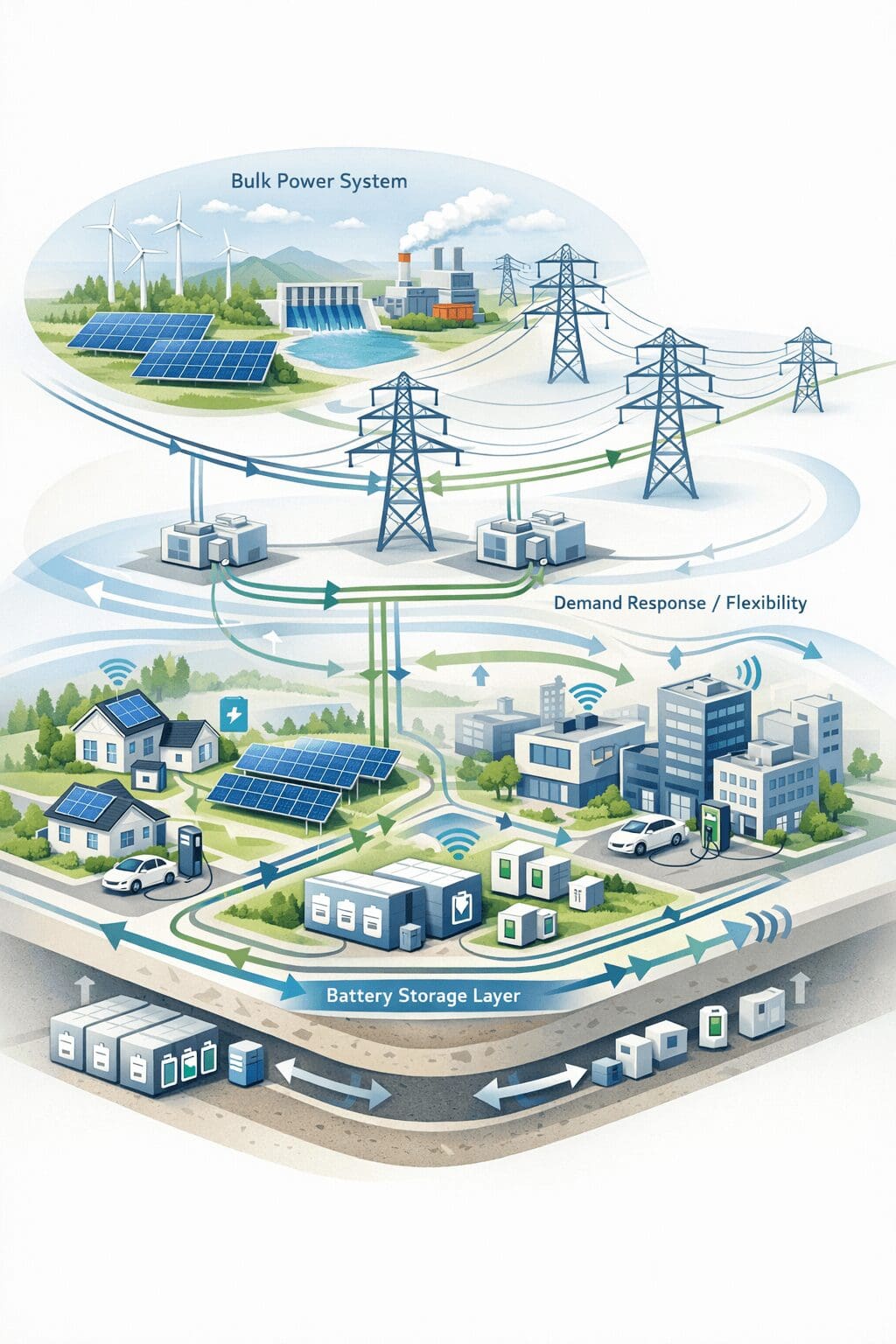
A common narrative in the energy transition is that the grid (power lines, substations, and vast transmission and distribution networks) will ultimately determine how fast we can scale new generation. Policymakers, utilities, and analysts point to massive interconnection queues, chronic congestion, and the need for trillions in new infrastructure as evidence that the system is already under strain.
The numbers are hard to ignore. The International Energy Agency (IEA) estimates that more than 3,000 GW of renewable projects (on the order of thousands of nuclear plants), are currently waiting in connection queues globally, while grid investment continues to lag far behind.
In Canada, the pressure is just as visible. Active generation interconnection requests exceed 45 GW across provinces. In Alberta, demand is being driven by large industrial loads such as data centers, with some proposing up to 21 GW of new demand against a provincial peak of just 12.8 GW.
Meanwhile, grid connection timelines for renewables routinely stretch into years, with backlogs, restudies, and limited interprovincial coordination slowing deployment despite strong policy support.
But is this true, or is it thinking grounded in an old paradigm?
The grid we inherited was engineered for a world of large, centralized thermal generators such as coal plants, gas-fired stations, and nuclear facilities. These plants were deliberately sited far from population centers to manage pollution, safety, and fuel logistics. Electricity flowed one way from these remote power plants across long-distance transmission lines to urban load centers. That design made perfect sense for yesterday’s technology. But with today’s generation options, could there be a different story?
The Old Paradigm: Why the Grid Was Built This Way
The modern electricity grid was not designed for flexibility, decentralization, or rapid iteration. It was built to solve a very specific problem: how to reliably deliver large amounts of power from a small number of centralized generators to rapidly growing population and industrial centers.
For most of the 20th century, electricity was produced by large thermal power plants, like coal, gas, and nuclear, that were located where fuel was available, land was cheap, and environmental and safety constraints could be managed. These facilities were often intentionally sited far from cities due to air pollution concerns, cooling requirements, and the logistical realities of fuel transport and handling. The result was a system in which generation and consumption were fundamentally separated by geography.
This separation made long-distance transmission essential. High-voltage transmission lines and expansive distribution networks became the backbone of the system, enabling electricity to flow in one direction, from remote power plants to urban load centers. This led to a planning philosophy built around large, centralized assets, connected through a robust transmission backbone, and distribution networks designed to deliver power outward like a one-way funnel.
Reliability was achieved through redundancy and scale. If one large generator failed, others would compensate. If demand grew, new large plants were added. The system was optimized for predictability, not variability; for controllable generation, not variable inputs like wind or solar.
Regulation, market design, and utility business models evolved around this structure. Rate-base regulation has historically favored capital-intensive infrastructure by tying utility returns to invested capital. Additionally, long-term planning cycles reinforced incremental expansion of the existing paradigm rather than structural redesign.
In many ways, this architecture was extraordinarily successful. It enabled industrialization, urbanization, and decades of stable economic growth. But it also embedded assumptions that generation would remain centralized, power would flow in one direction, and scale would always be more efficient than distribution.
Those assumptions are now being tested.
The New World: Generation That Plays by Different Rules
While the traditional grid was built around centralized, controllable generation, today’s energy landscape is increasingly shaped by resources that are smaller, more modular, and far more flexible in how, and where, they can be deployed.
One of the most important shifts is siting flexibility. Wind, solar, hydroelectric, and geothermal resources no longer inherently require remote siting in the way thermal generation once did. While the highest-quality wind, hydro, and geothermal resources are still often geographically constrained, a growing share of new capacity, particularly solar, can be located directly at or near load. Rooftop solar transforms homes, warehouses, and commercial buildings into generation assets. Community solar extends that model to shared infrastructure, allowing participation without on-site installation. Even geothermal, in its newer forms (e.g., enhanced geothermal systems), is beginning to expand beyond historically narrow geographic limits. The result is a partial decoupling of generation from long-distance transmission requirements.
At the same time, distributed energy resources (DERs), battery energy storage systems (BESS), and smart devices are reshaping how supply and demand are balanced. Instead of relying exclusively on large, centralized plants to follow load, modern systems can increasingly shape load to follow generation. A well-known example is California’s “duck curve,” where midday solar oversupply and steep evening ramps once posed major operational challenges. Today, a combination of utility-scale storage, demand response programs, and distributed batteries is actively flattening that curve. Virtual power plants (VPPs), which aggregate thousands of small assets like home batteries, EV chargers, and smart thermostats, are now being deployed to provide grid services traditionally reserved for large generators.
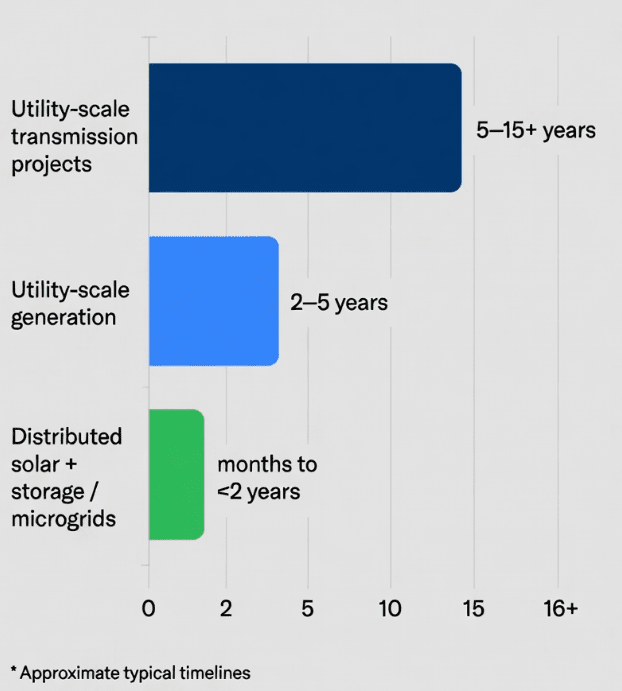
Microgrids and mini-grids add another layer of flexibility, particularly in edge cases where traditional grid expansion is slow, costly, or impractical. While they are not a substitute for bulk power systems, they can reduce reliance on traditional infrastructure, defer substation upgrades, and accelerate deployment timelines where grid expansion is slow or uneconomic. In remote or terrain-challenged regions, such as northern communities, islands, or mining operations, studies have shown that hybrid systems combining solar, storage, and backup generation can outperform diesel-based or transmission-extension alternatives on both cost and deployment speed. In these contexts, microgrids are often the economically rational choice.
Figure 1 (conceptual): Levelized Cost of Energy (LCOE) Comparison
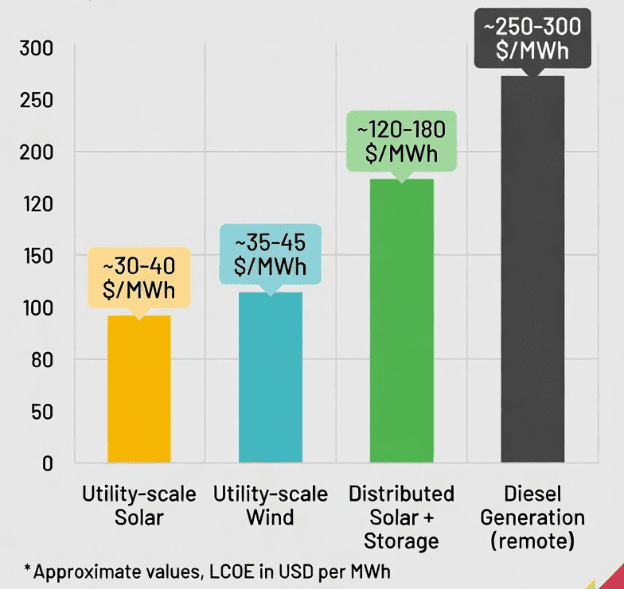
Figure 2 (conceptual): Deployment Timelines
However, these advantages come with real constraints. Resource quality and siting impacts performance, meaning urban solar cannot fully replace high-capacity-factor wind or hydro. Distributed systems also face scale limitations, particularly in dense urban or heavy industrial environments. And while local balancing can reduce strain on the grid, it does not eliminate the need for broader system coordination.
The Reality Check: Why Grid Expansion Is Still the Governing Factor
For all the promise of distributed systems and localized generation, the reality is that physics, geography, and the scale of the energy transition still point back to the grid as a central constraint.
IEA analysis shows that more than 3,000 GW of renewable projects are currently sitting in interconnection queues globally, which far exceeds the capacity of existing grids to absorb them. In many regions, projects are not being delayed because they are uneconomic or technologically unviable, but rather because they simply cannot connect to the grid. Developers face multi-year studies, restudies, and uncertain upgrade costs, often leading to cancellations or indefinite delays. The Canada Energy Regulator and provincial system operators have similarly identified transmission constraints and interconnection bottlenecks as key barriers to scaling clean electricity, particularly in high-growth regions such as Alberta and Ontario.
Curtailment and congestion add another layer of friction. In regions with high renewable penetration, grid constraints increasingly force operators to turn off low-cost wind and solar because there is insufficient transmission capacity to deliver that power to where it is needed. This represents lost clean energy, reduced project revenues, and, in some cases, continued reliance on higher-emissions generation elsewhere on the system.
Figure 3 (conceptual): Global Interconnection Queues vs Installed Capacity
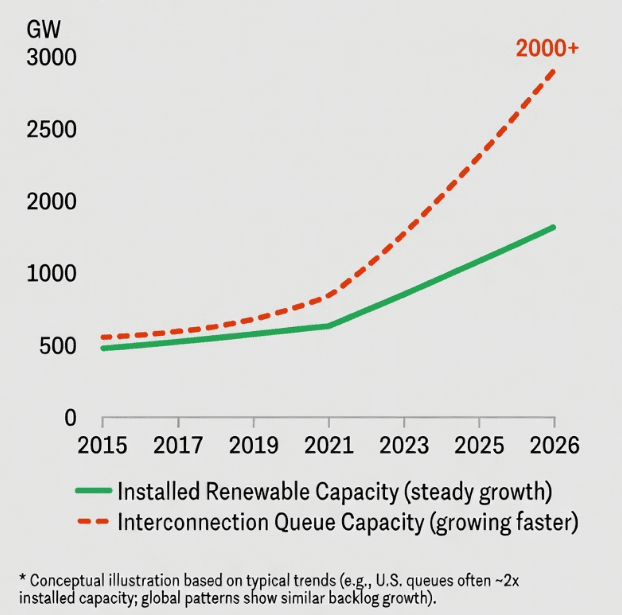
Figure 4 (conceptual): Grid Investment vs Generation Investment
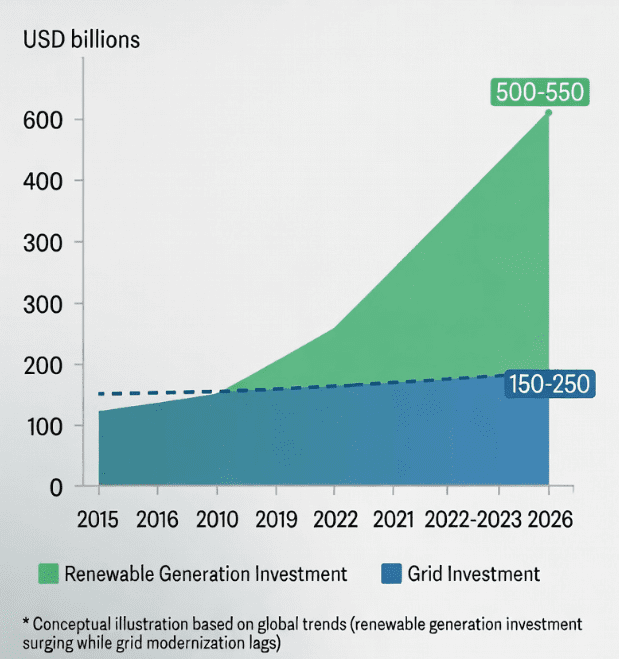
Geography remains a stubborn constraint. The best wind resources are often located in sparsely populated regions or offshore. Large-scale hydroelectric resources are inherently site-specific. Even solar, while flexible, achieves its lowest costs in high-irradiance areas that are not always co-located with demand centers. If the goal is to deliver the lowest-cost clean energy at scale, then moving electricity over long distances is essential.
Then there is the sheer scale of electrification. Electric vehicles, heat pumps, data centers, and industrial electrification are all driving load growth at a pace not seen in decades. Meeting that demand with variable renewable energy introduces system-wide balancing challenges that extend beyond any single building, neighborhood, or microgrid. Even with widespread deployment of BESS and demand response, there are limits to how much variability can be managed locally. Geographic diversity, enabled by transmission, remains one of the most effective tools for smoothing variability across time and space.
Distributed solutions, while powerful, also face practical constraints. Hosting capacity on distribution networks can limit how much rooftop solar or behind-the-meter storage can be added without upgrades. The levelized cost of energy for distributed systems, particularly when paired with storage, is often higher than utility-scale alternatives on a pure generation basis. Regulatory frameworks can lag behind technology, creating barriers to aggregation, market participation, and compensation for services provided by DERs and virtual power plants.
Microgrids, too, have limits. While they can be cost-effective and fast to deploy in specific contexts, especially in remote or resilience-critical applications, they do not scale easily to serve dense urban centers or energy-intensive industrial loads.
The Hybrid Future: Not Either/Or, But Both/And
The most realistic, and arguably most powerful, vision for the energy transition is not a choice between centralized grids and distributed energy, but a hybrid system where both evolve in parallel and reinforce each other.
In this model, DERs, battery energy storage systems (BESS), microgrids, and demand-side flexibility reshape how the grid is used. Rooftop solar and distributed storage reduce net demand at peak times. Virtual power plants aggregate thousands of small assets into dispatchable resources. Smart loads, such as EVs, industrial processes, and building systems, begin to respond dynamically to price signals and grid conditions. These tools collectively flatten peaks, absorb variability, and reduce stress on constrained parts of the system.
At the same time, the bulk power system remains essential. But instead of indiscriminately expanding it, the focus shifts toward smarter and more targeted reinforcement. Grid-enhancing technologies (GETs), such as dynamic line ratings, advanced power flow controls, and topology optimization, can increase throughput on existing infrastructure without new construction. Better forecasting, interconnection reform, and planning coordination can reduce delays and eliminate redundant or misaligned investments. In many cases, these approaches can defer or entirely avoid costly transmission upgrades.
There are already early signals of this hybrid approach working in practice. In regions with high DER penetration, targeted deployment of storage and demand response has deferred the need for peaking capacity and reduced congestion on local feeders. In other cases, localized microgrids have allowed industrial or remote developments to proceed without waiting for multi-year transmission builds, effectively bridging the gap between demand growth and grid expansion timelines.
The key insight is that flexibility comes from multiple layers of the system, rather than just one. Generation, consumption, storage, and transmission can all contribute to balancing supply and demand, each in different ways and at different scales.
Ultimately, the hybrid future is about using each tool where it is most effective, and allowing the system to evolve into something more adaptive, modular, and resilient than the architecture it replaces. Done well, this approach will likely be faster, cheaper, and more politically durable than any single-path alternative.
What This Means for the Transition
If the energy transition is neither purely centralized nor purely distributed, then the policy and investment frameworks guiding it need to reflect that reality. The challenge is no longer deciding whether to build more grid or more distributed resources, but how to coordinate both intelligently and at speed.
For policymakers, the implication is clear: permitting and regulatory systems must accelerate on both fronts. Large-scale transmission still needs streamlined approvals and better cross-jurisdiction coordination, especially where it unlocks high-quality renewable resources. At the same time, distributed energy systems (rooftop solar, storage, microgrids, and demand response) require fewer barriers to deployment and clearer pathways for market participation. Treating these as competing priorities is a false choice as both are necessary to reduce system friction.
For utilities and system operators, the focus shifts toward flexibility as a planning resource. Grid-enhancing technologies, improved forecasting, and dynamic operational tools should be treated as core infrastructure strategies, rather than experimental add-ons. Planning frameworks must begin to value avoided infrastructure, not just built infrastructure, recognizing that demand-side flexibility and DER aggregation can defer or eliminate costly upgrades.
For investors, developers, and even homeowners, the message is similarly pragmatic. Value will increasingly accrue to solutions that sit at the intersection of generation, storage, and intelligence. Participation in the energy system will become more distributed, but also more coordinated.
The risk is that the transition gets stalled between two ideological extremes, with one betting entirely on massive grid expansion, and the other assuming decentralization alone can carry the load. The opportunity lies in rejecting that binary altogether.
A pragmatic hybrid approach, where centralized and distributed systems evolve together, offers the most credible path forward. It is not the simplest vision, but it may well be the one that actually works.